
Don't have the books yet?
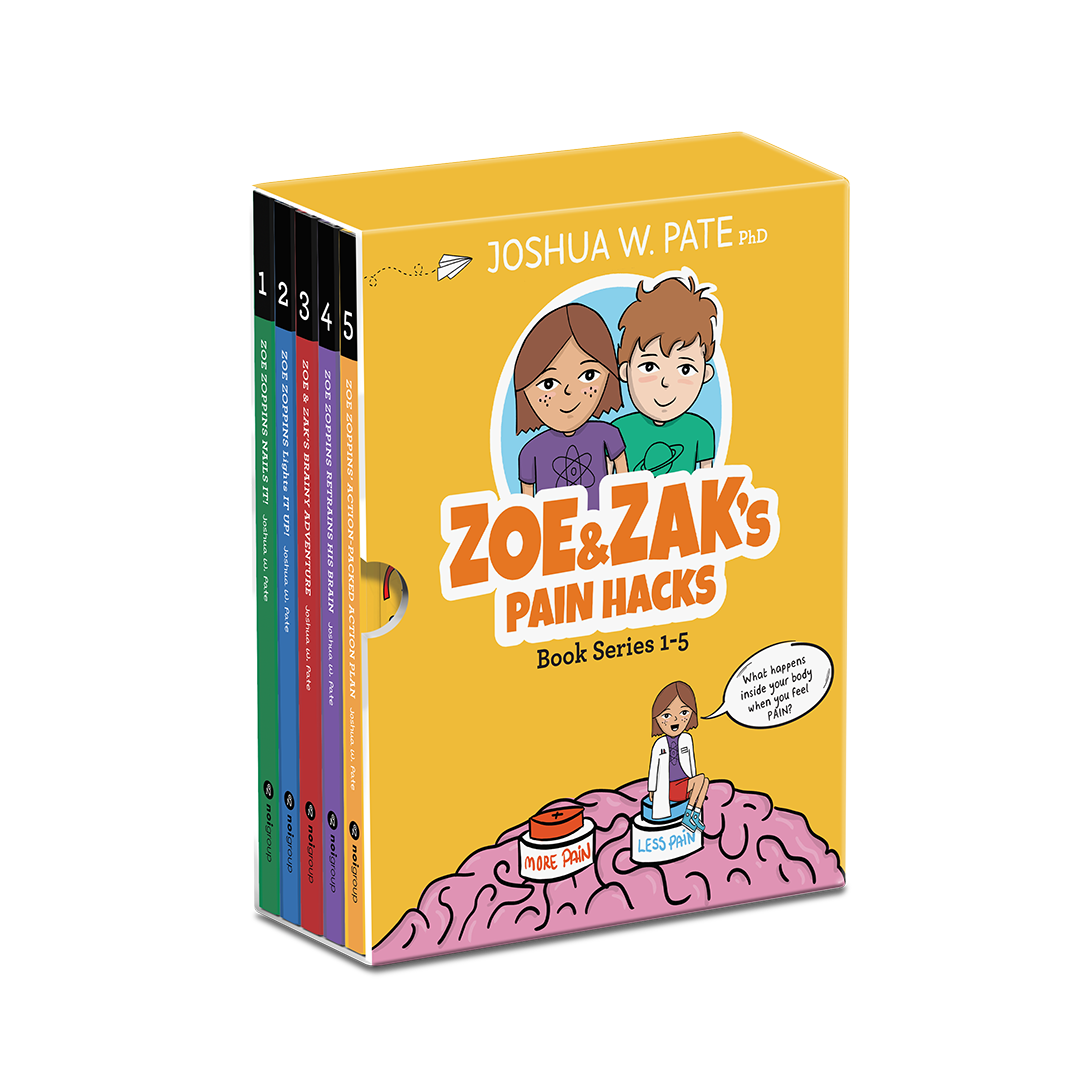
The five Zoe and Zak's Pain Hacks books are designed to help children, family, friends, teachers and health professionals all learn about pain, especially pain that has persisted longer than it should. The books are sold as a box set, and each book builds up to the final fifth book which provides the framework for the child's own action plan. Used together, these books are targeted pain science education at its best – use them to help children thrive!
Meet the author
Noigroup Publications
Neuro Orthopaedic Institute
19 North Street, Adelaide City West
South Australia 5000 Australia
+61 (0)8 8211 6388
www.noigroup.com
Contact the author
Contact the publisher
First Name (required)
Last Name
Email (required)
Type your message here...
SubmitWhich book?
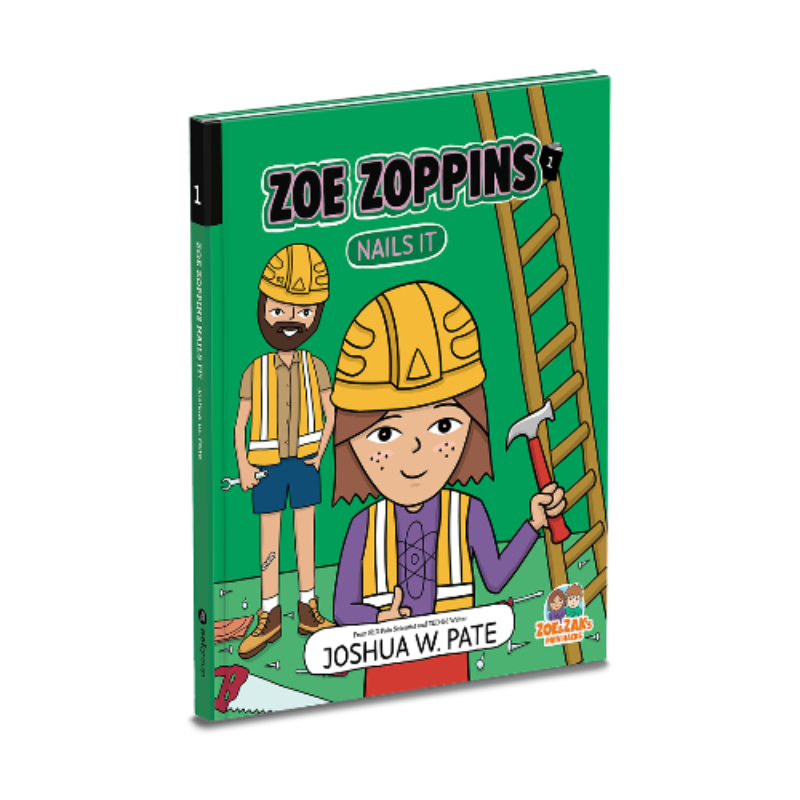
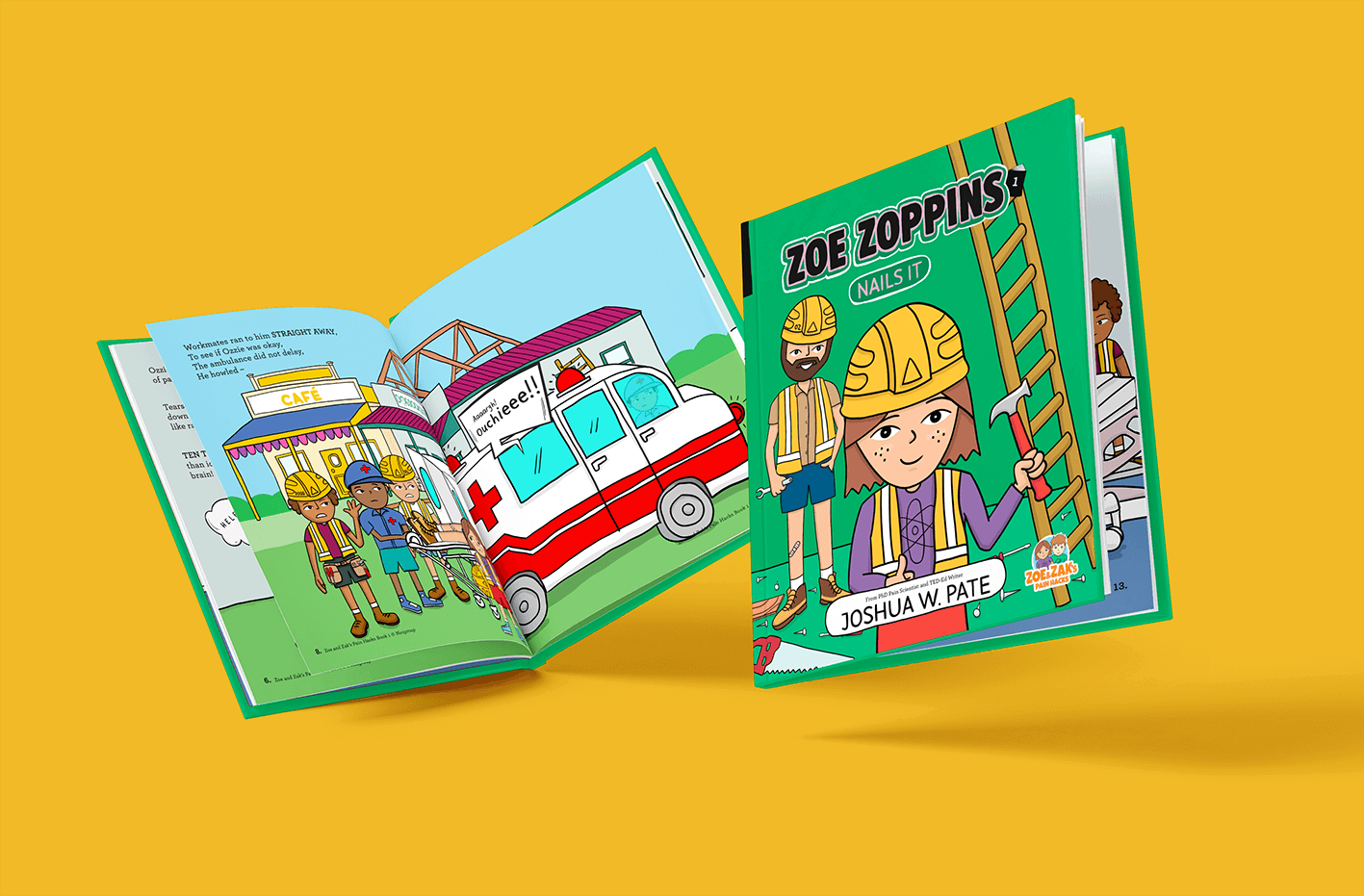


Now that you have read Zoe Zoppins Nails it (book 1) you are ready to take on the next challenge!
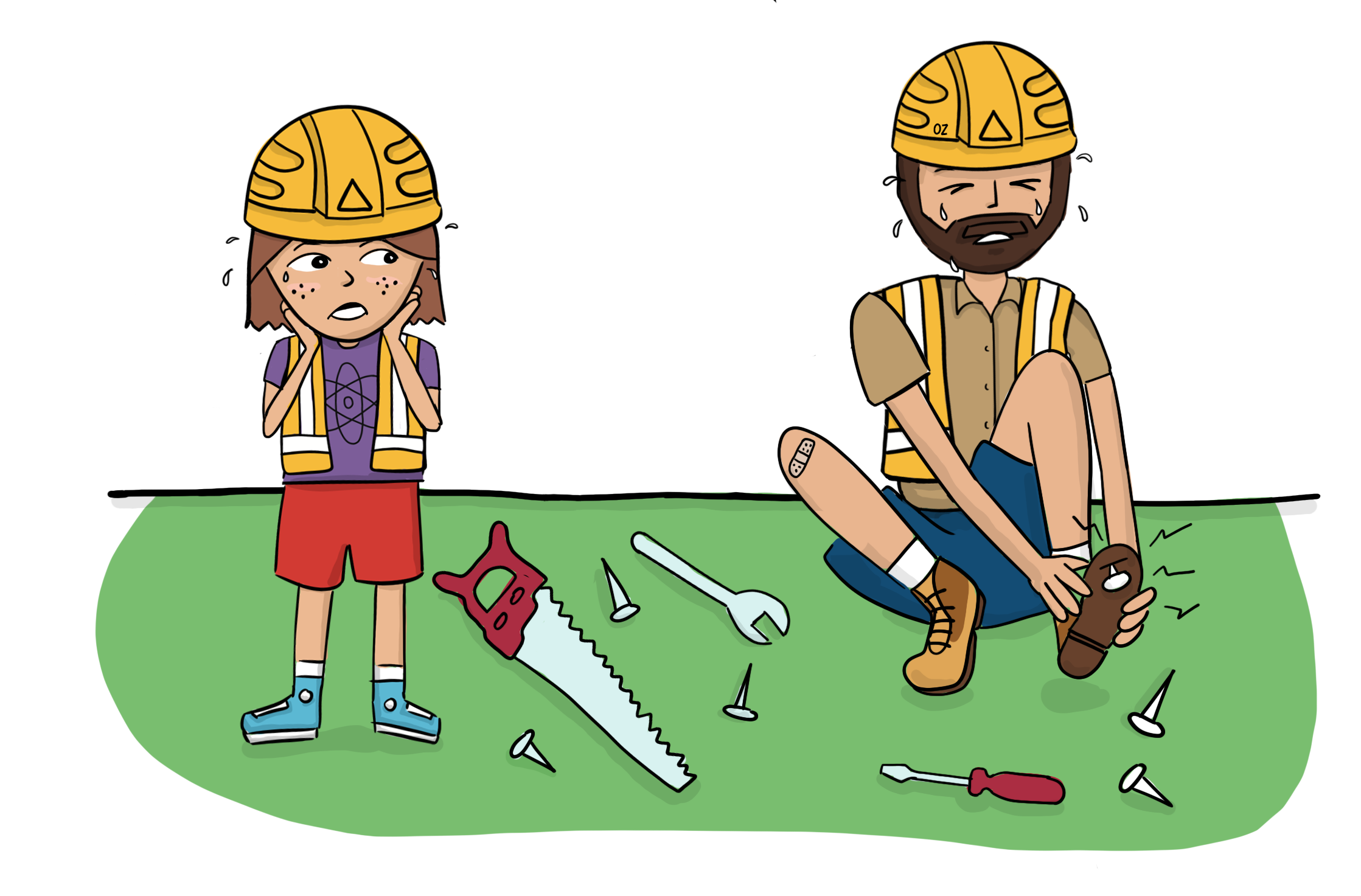
Let's recap the 1st story:
Zoe is with her Uncle Ozzie on his building site, suddenly he has an alarming accident! Doug and Dell sound the alert and Ozzie is raced to hospital. They are in for a BIG SURPRISE when the doctor takes a look.
In the end, they all learn that feeling pain does not necessarily mean your body is damaged.
Get set for some cool activities...
Here are some printable sheets for you to get stuck into...
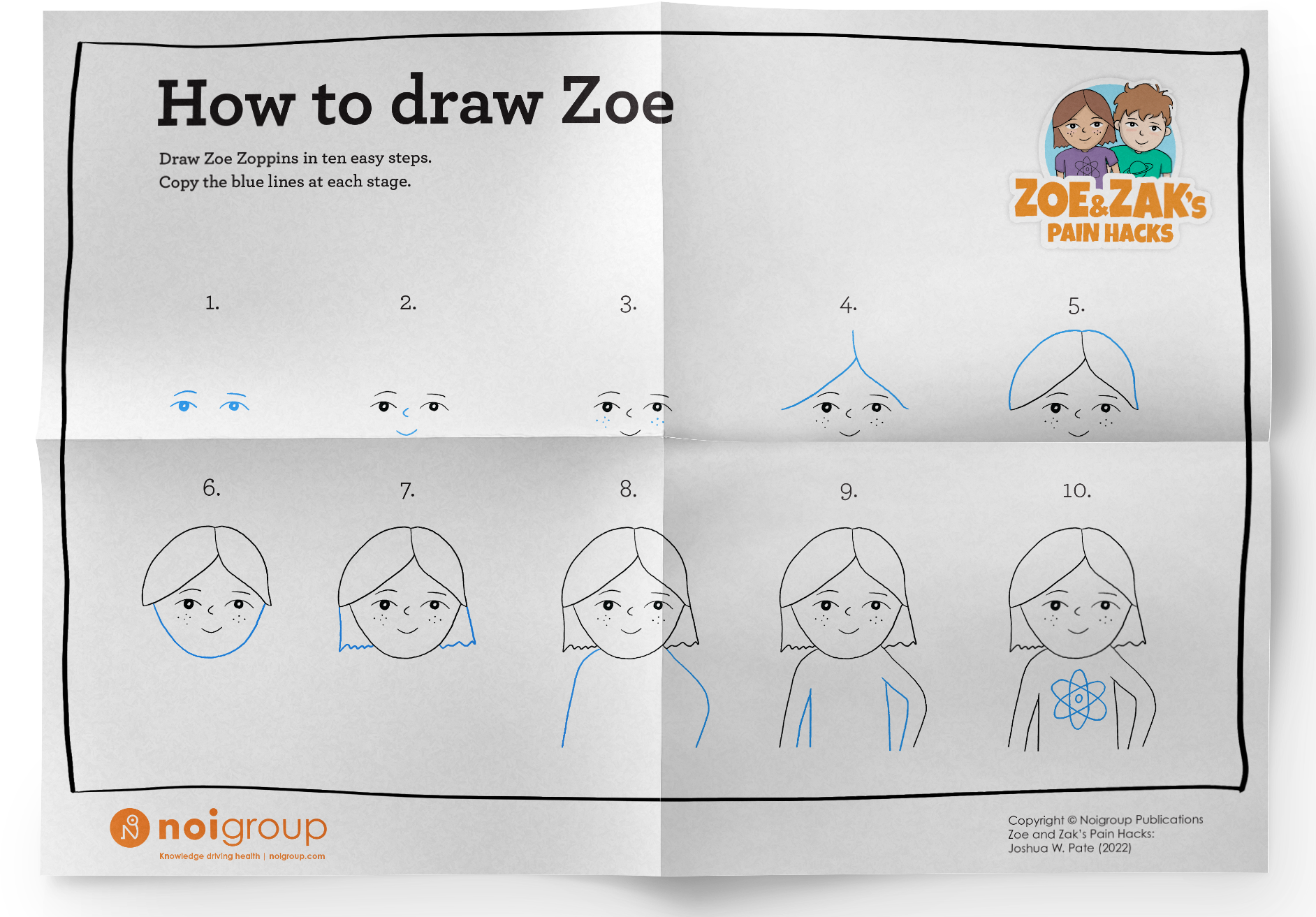
How to Draw Zoe
You can draw a picture of Zoe. Follow the ten easy steps.
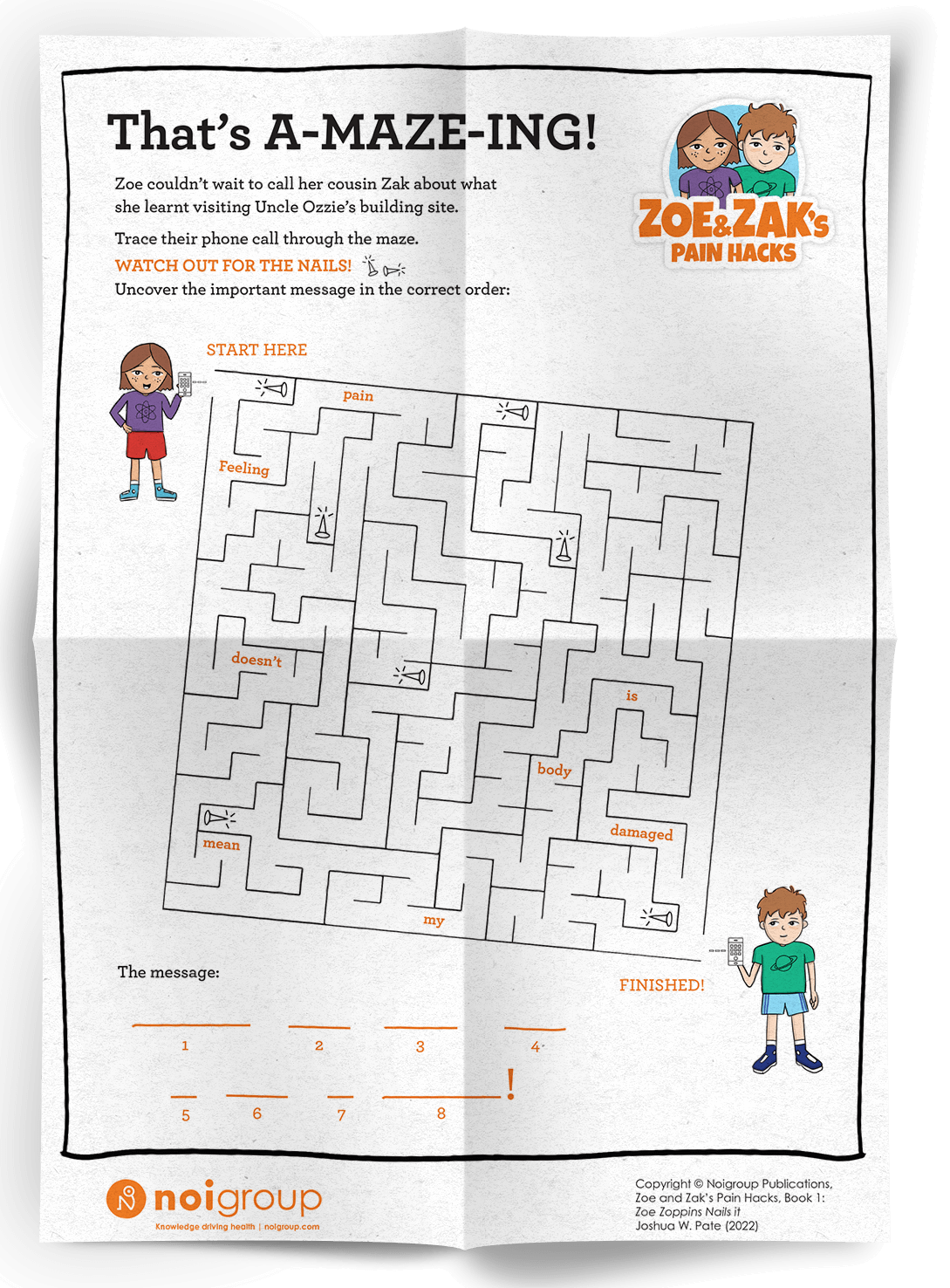
Maze Message
Trace Zoe and Zak's phonecall through the maze collecting the words along the way. Be careful to avoid the nails!
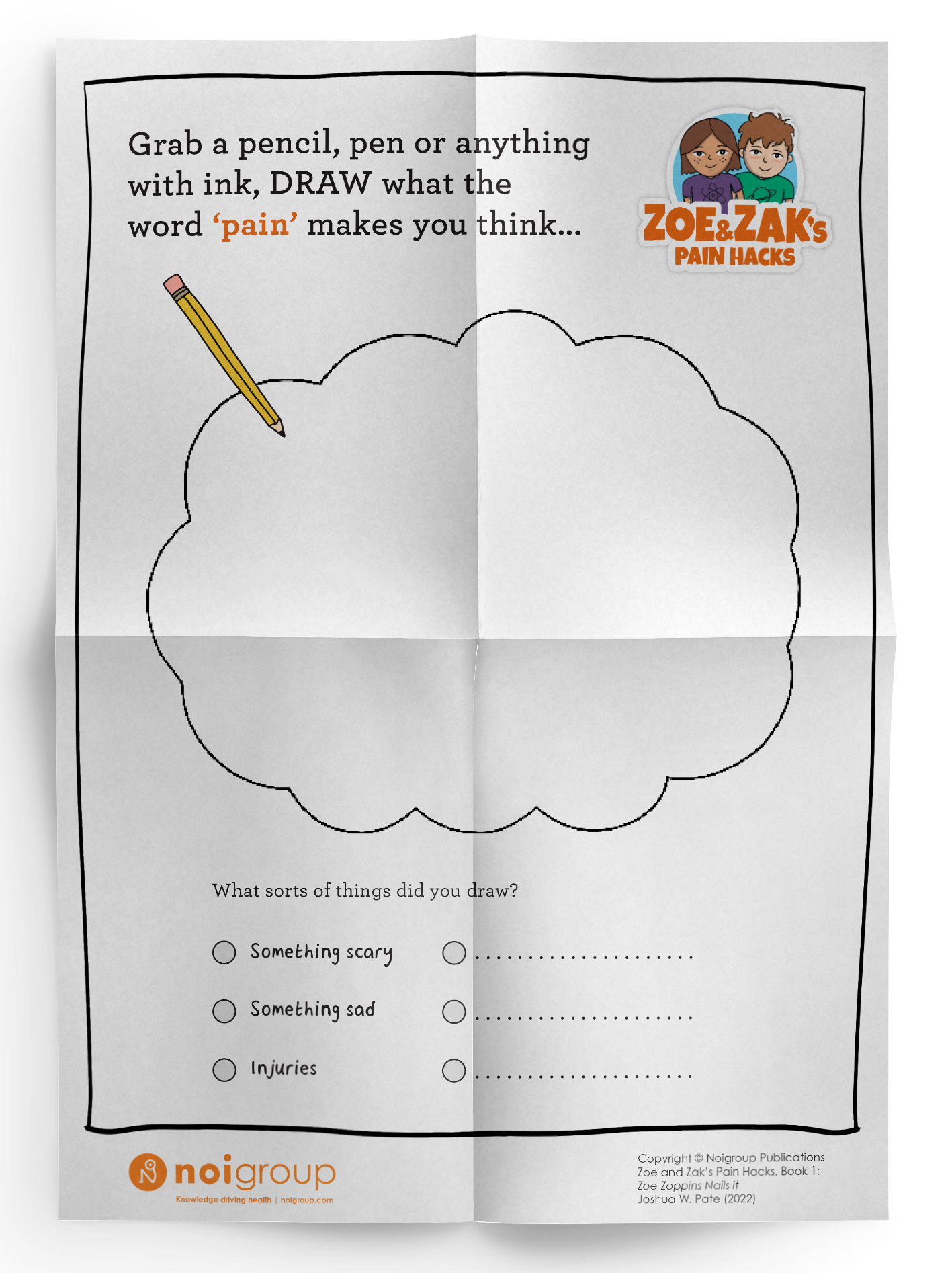
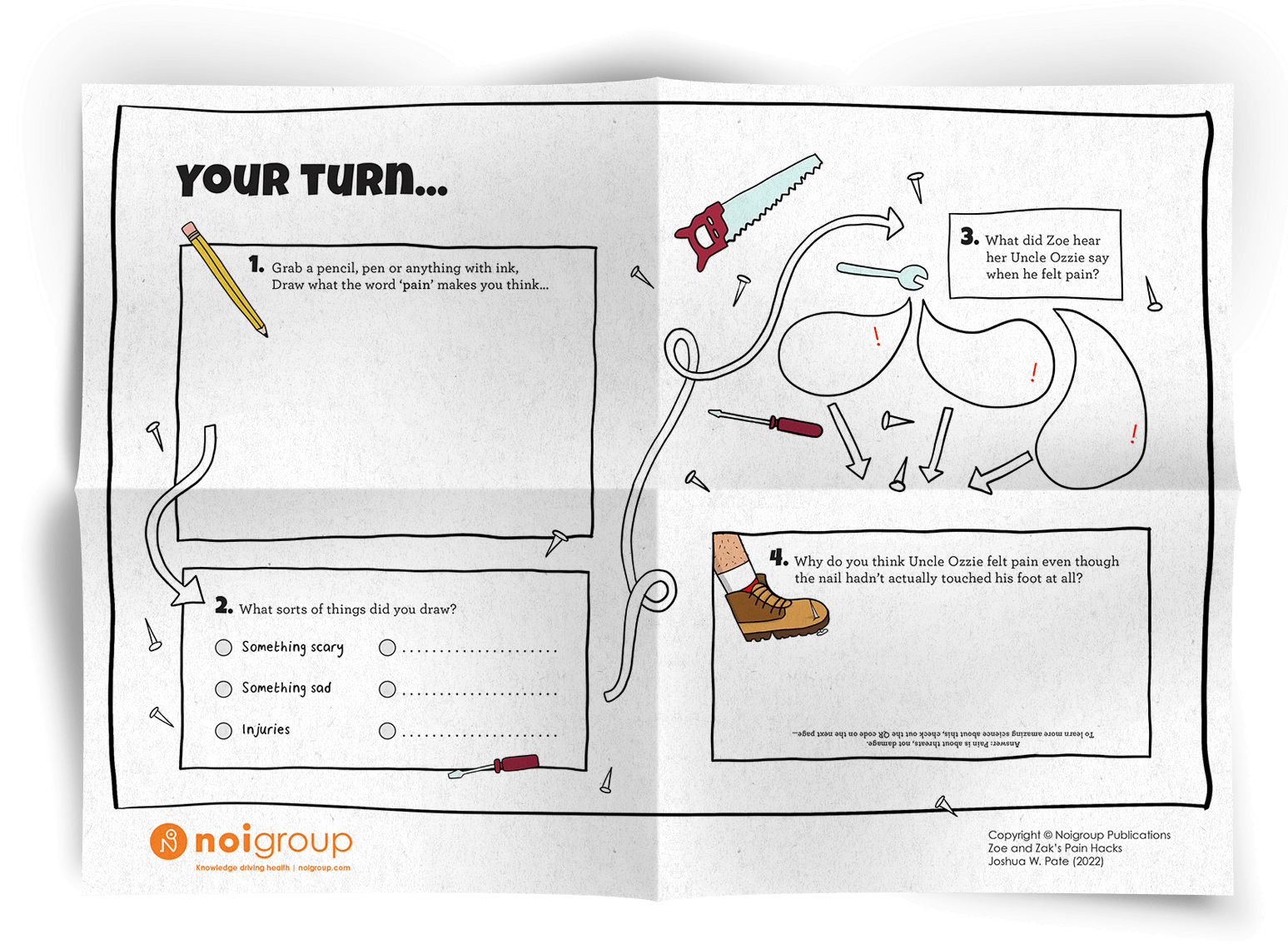
Drawing Pain
Can you draw what pain looks like, or feels like?
More questions to get you thinking!
1. A papercut is a nice example of a tiny bit of damage to your body causing a lot of pain. Can you think of any other examples?
2. A soldier with an injury is a good example of a lot of damage to your body but not feeling much pain. Can you think of any other examples of this?
3. Look at page seven again. Here, we are imagining that in our brains there are MORE PAIN and LESS PAIN buttons. It helps us understand how many different things influence every time we feel any pain. How many characters are jumping on Ozzies's MORE PAIN button?
4. Have you ever felt pain and then discovered you weren’t injured/your skin and bones were fine?
5. Ozzie was helped by a few different people in this book. Select all of the possible people that might be able to help YOU when you feel pain:
- Doctors
- Physiotherapists
- Psychologists
- Parents
- Brothers
- Sisters
- Grandparents
- Friends
- Teachers
- School counsellors
- Occupational therapists
- Music therapists
- Nurses
- Ambulance officers
- Hospital-school liaisons
6. How could you use the story of Zoe at the building site to help you next time you feel sore?
Thanks for sharing!
Hint for Question 5: Perhaps
ALL OF THOSE PEOPLE might be helpful!
Want MORE activities? Select another book...
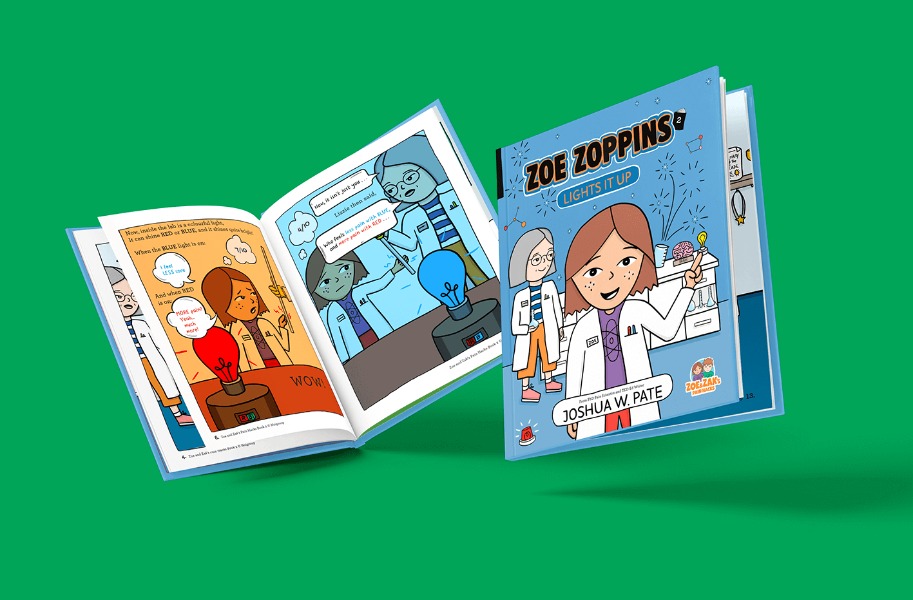
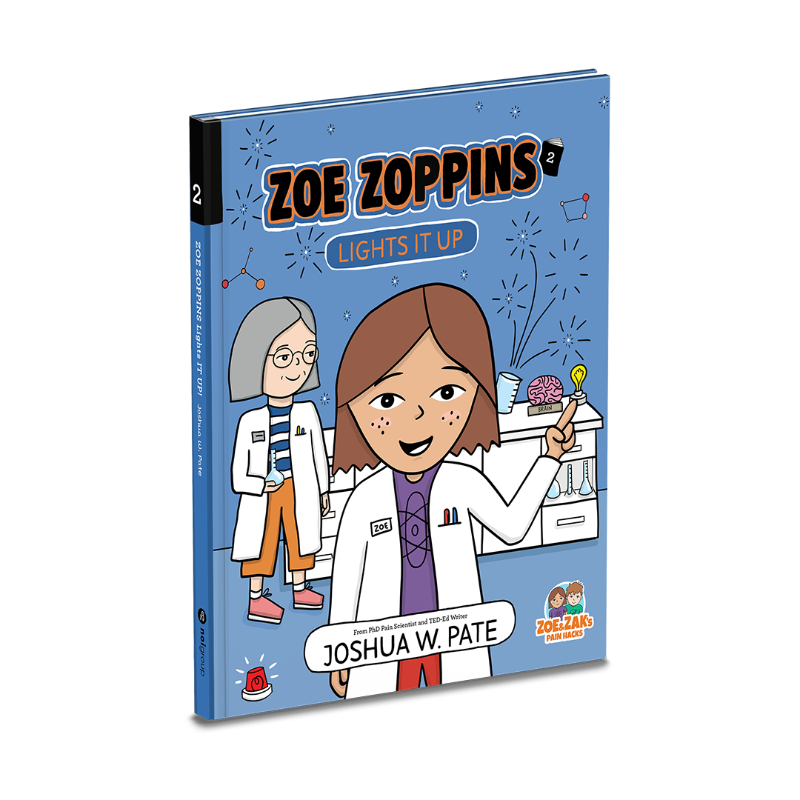
Now that you have read Zoe Zoppins Lights it up (book 2) you are ready to take on the next challenge!
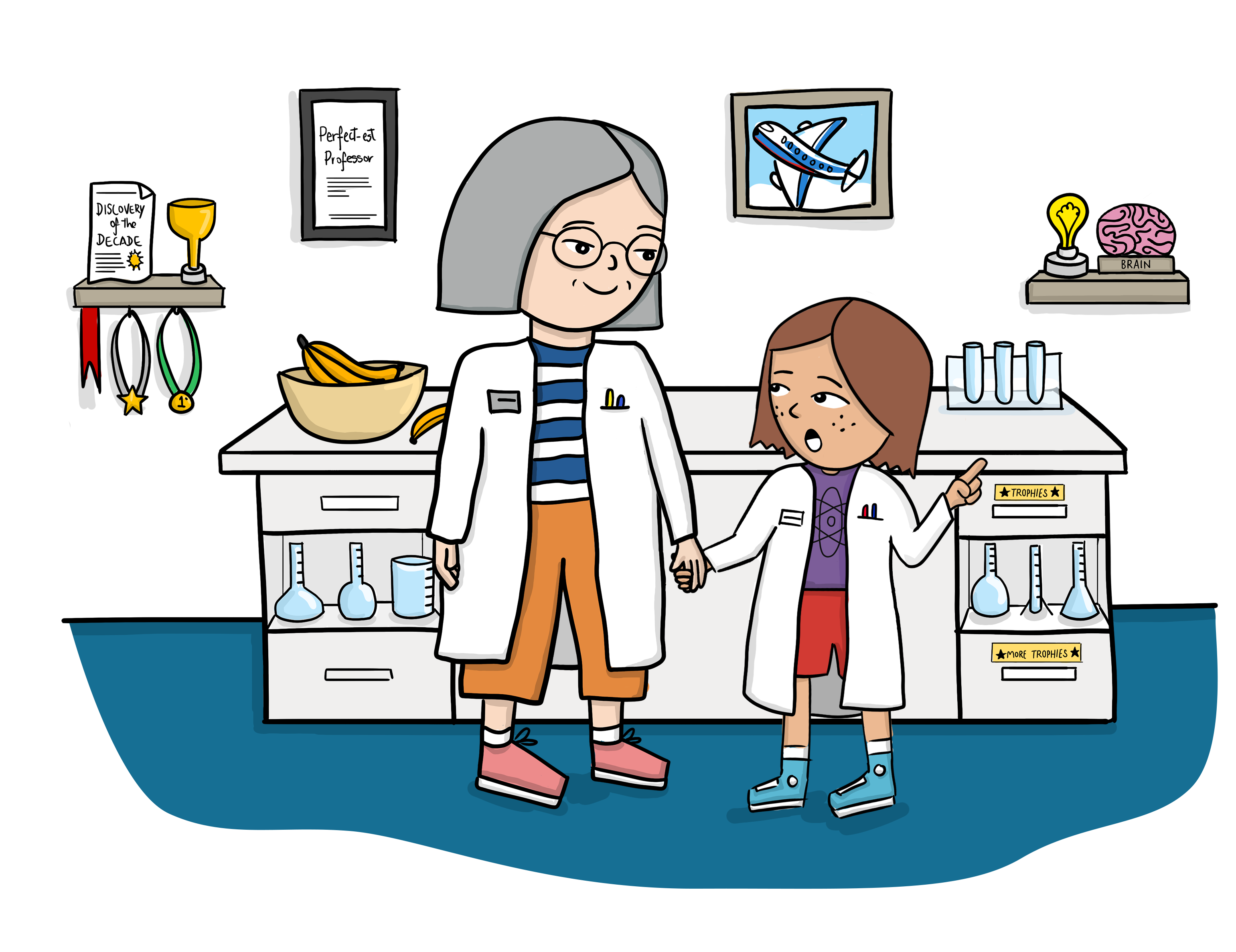
Let's recap the 2nd story:
Zoe visits her Grandma Lizzie in her amazing science lab. Zoe asks her all sorts of questions! Lizzie demonstrates colourful experiment which reveals something amazing about pain and the brain. Zoe learns that ANYTHING and EVERYTHING can change her pain!
Get set for some cool activities...
Here are some printable sheets for you to get stuck into...
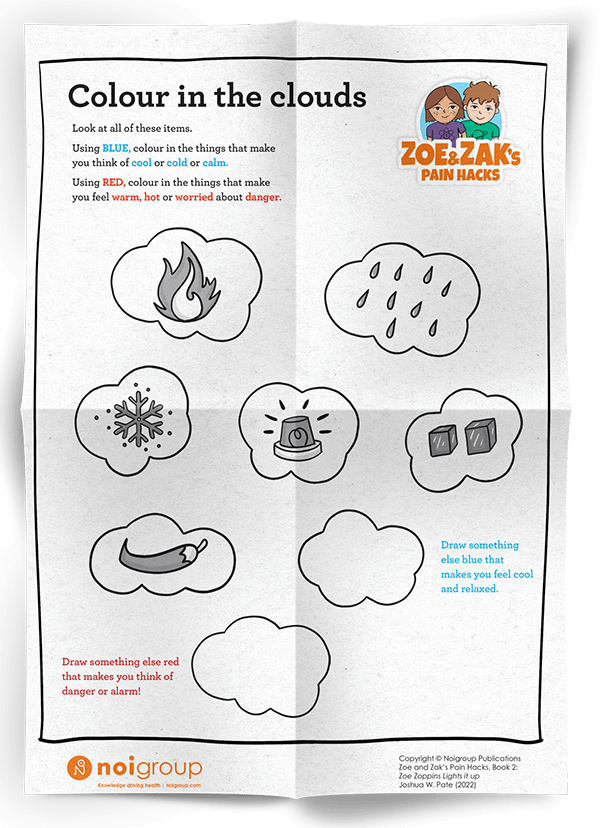
Hot and cold
You will need red and blue pencils, crayons or textas for this one.
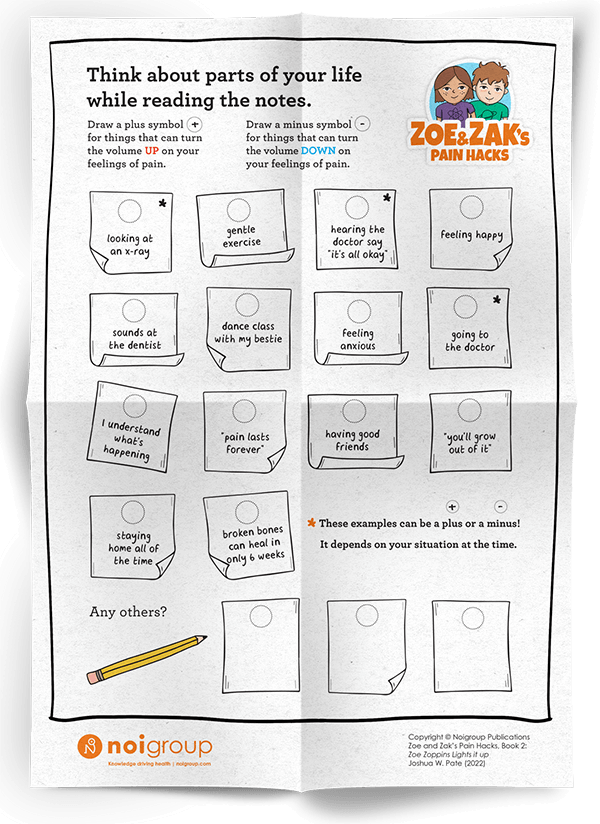
Pain volume 1.
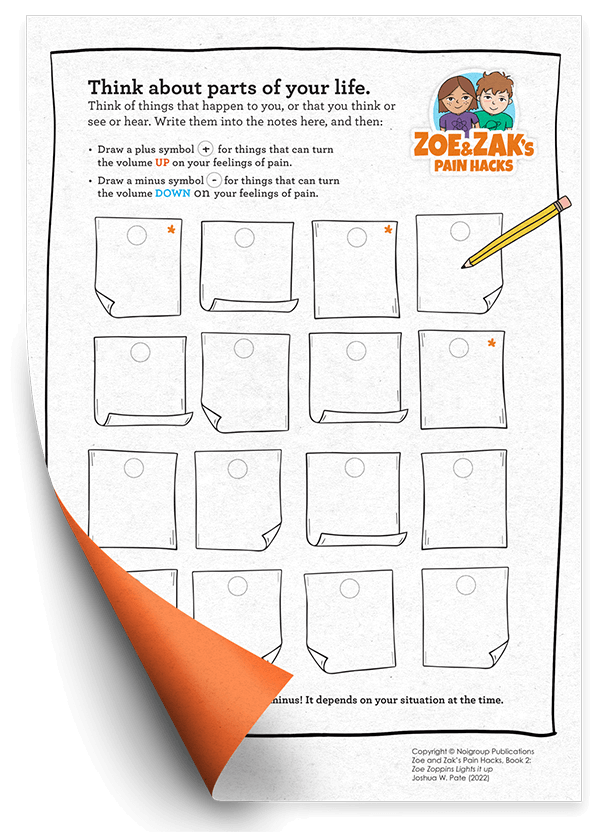
Think about things in your life that may make your feeling of pain go up or down. We have given you some ideas.
Pain volume 2.
Write down things in your life that may make your feeling of pain go up or down.
Quiz
Share your thoughts...
This book had three questions at the end, so let’s kick off with question 4…
4. Have you ever tried distracting yourself on purpose? Eg. Maybe when you felt cranky you went outside to play, or you picked up your guitar and strummed along to a song? Ask someone at home about distraction and when it might be useful.
5. Can you draw a picture that shows how the blue light made Zoe feel less pain?
6. In the book, Zoe realises: “If a little light can change the volume of pain, Plenty MORE is possible in your brainy brain”. Which of the 8 characters on page 14 have you noticed in your own life? Tick them:
- See
- Fear
- Feel
- Think
- Expect
- Remember
- Move
- Understand
7. Can you come up with any other ideas that might change your feeling of pain?
8. How could you use this story to help you next time you feel sore?
Want MORE activities? Select another book...
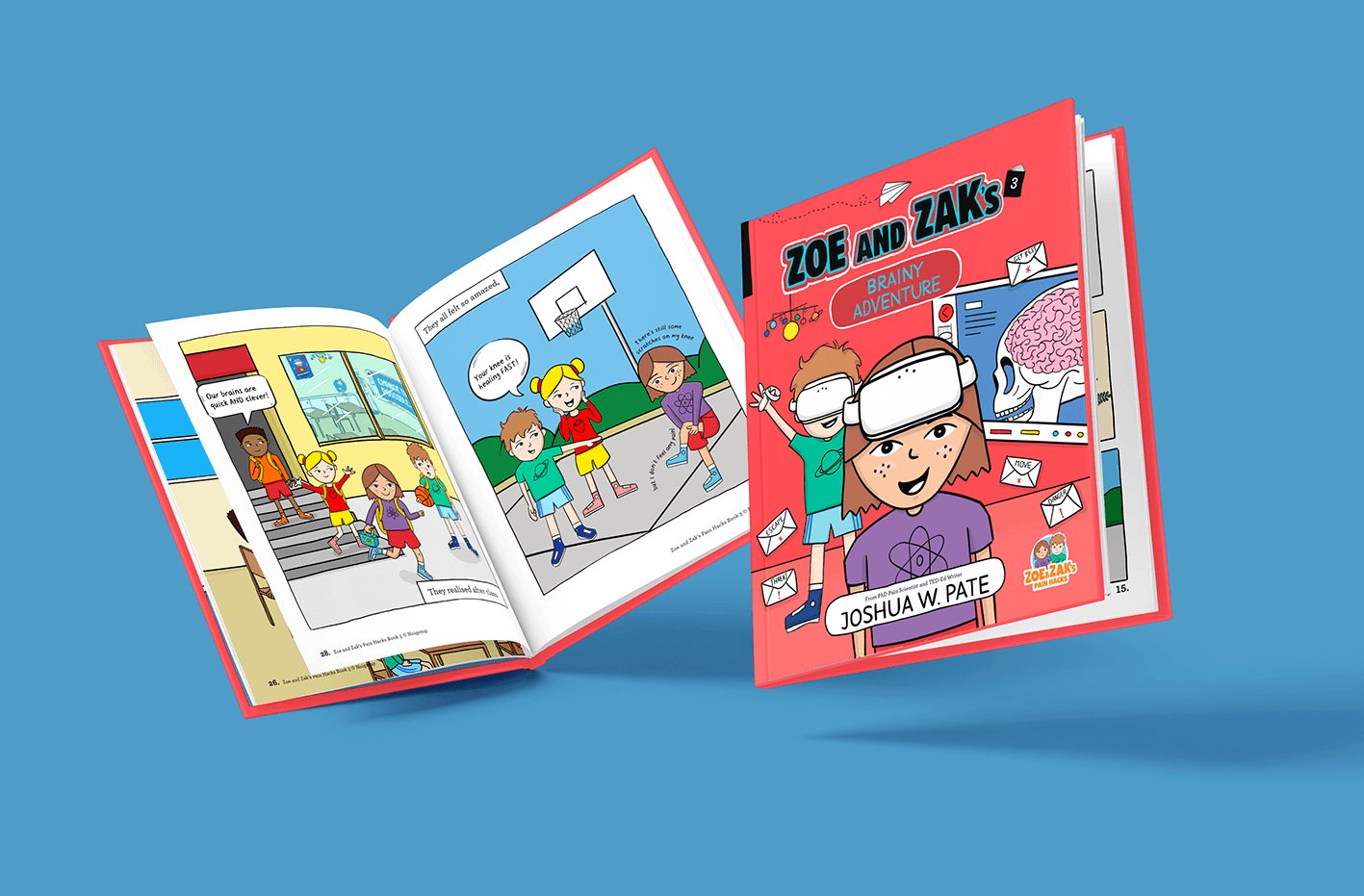
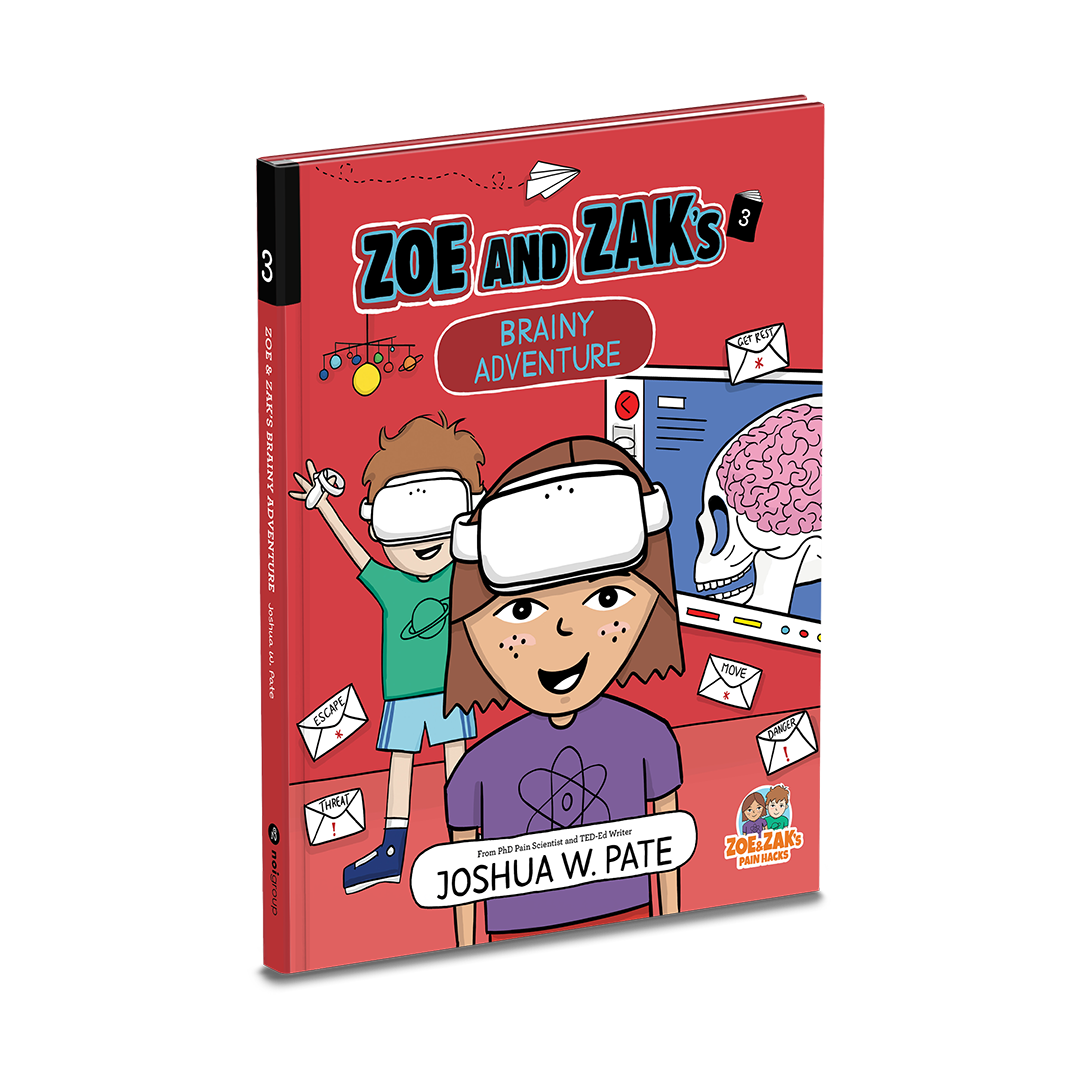
Now that you have read Zoe and Zak's Brainy Adventure (book 3) you are ready to take on the next challenge!
Let's recap the 3rd story:
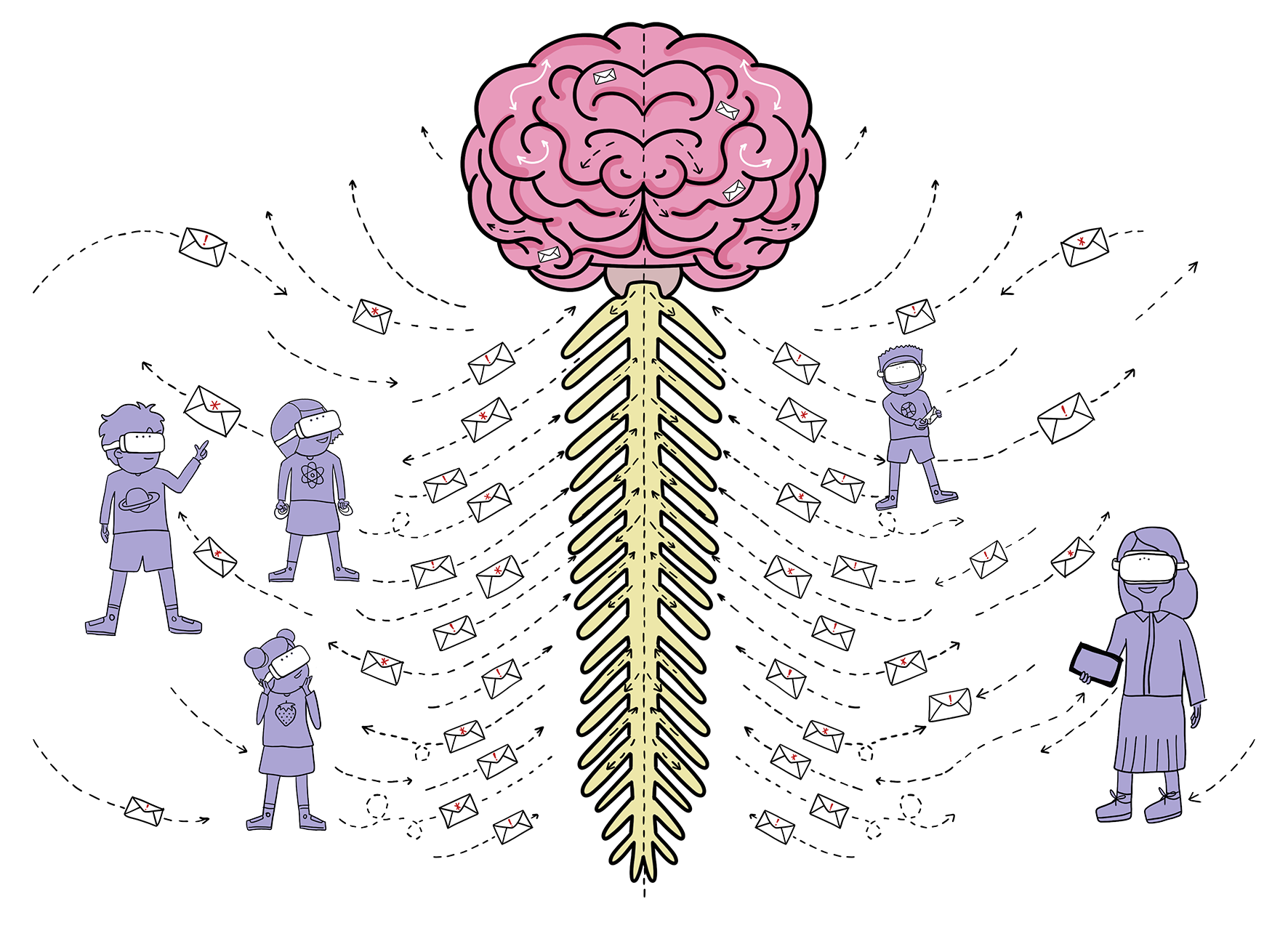
Zoe and her cousin Zak are in the same class at school. Before science class, Zoe tumbles and hurts her knee but is keen to keep going so she doesn't miss her favourite class with Ms Zimmer. The students are taken on an exciting virtual reality experience. They see inside the brain where there are messages zipping to and fro with alerts and advice for action! They learn that while pain can be a good protector, if it goes on for too long it can become unhelpful.
Get set for some cool activities...
Here are some printable sheets for you to get stuck into...
Puppet show
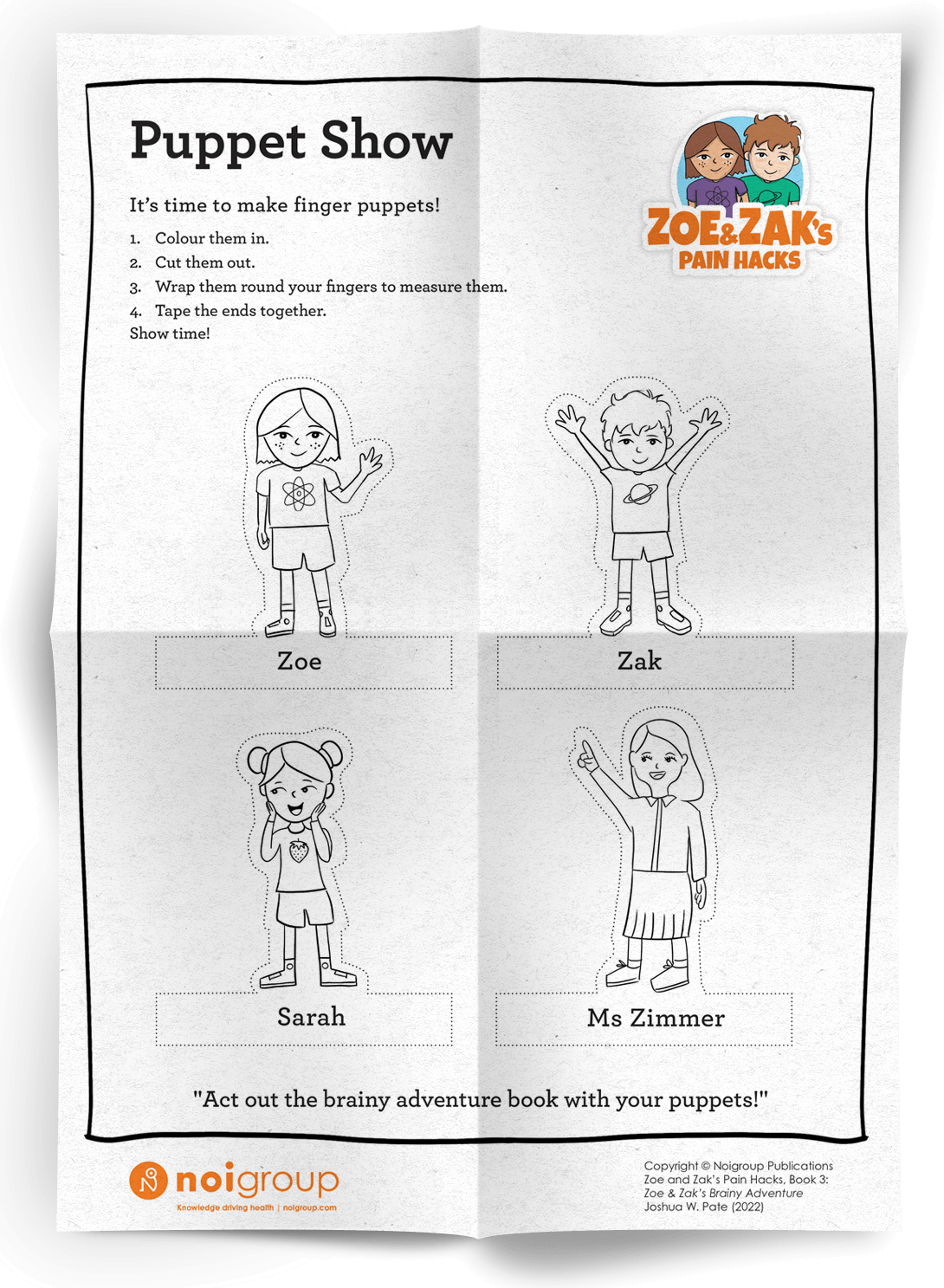
Colour in and cut out the characters, then tape onto your fingers to re-enact the Brainy Adventure story!
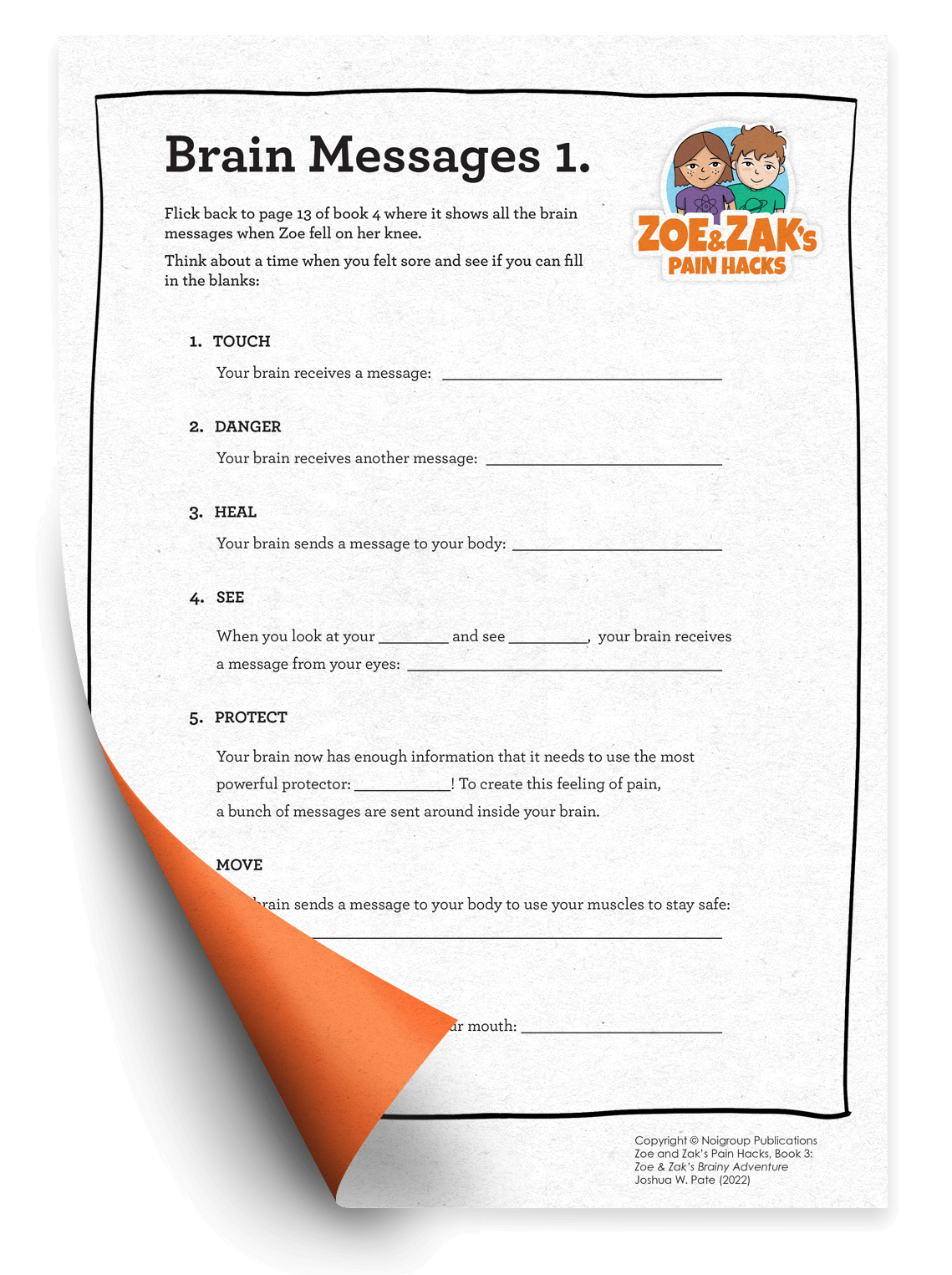
Brain messages
Think about things in your life that may make your feeling of pain go up or down.
Quiz
This book had five questions at the end, so let’s kick off with question 6…
6. Imagine your friend was feeling pain for a really long time. Their brain has become SUPER-PROTECTIVE ('a heightened state'). Can you think of a story of what's happening inside their body with this unhelpful SUPER-PROTECTION?
Eg. It's like a smoke detector going off when a fly lands on it!
Eg. It's like soldiers in an army, advancing too much!
7. When pain lasts for more than 3 months, many people start to notice that their pain spreads to other nearby body parts. Scientists call this ‘brain map smudging’. We have a map in our brain (called our ‘homonculus’), and the map gets blurrier after a few months of trying to keep us safe… so our brain protects MORE areas around the body part that first started hurting. If this sounds pretty crazy, check out this video - https://ed.ted.com/lessons/the-fascinating-science-of-phantom-limbs-joshua-w-pate
The most exciting thing about all this, is that the brain doesn’t get totally stuck with the new map – it is always changing!
8. Your brain is REALLY powerful! Learning stuff actually makes room in your brain to learn more stuff!
This isn’t a question, it’s a challenge for you: Go and tell someone this and see what they say!
9. When you have your vaccine, you are protected. Sometimes you feel a bit sick: that’s your immune system learning how to protect you.
Ask an adult who’s at home with you about the immune system and how pain relates to it. If you aren’t sure, have a look at Explain Pain with them.
Our brains are always doing their best to keep us safe. In the next book we’ll learn about how our brains can be retrained!
Did something here stand out?
Want MORE activities? Select another book...
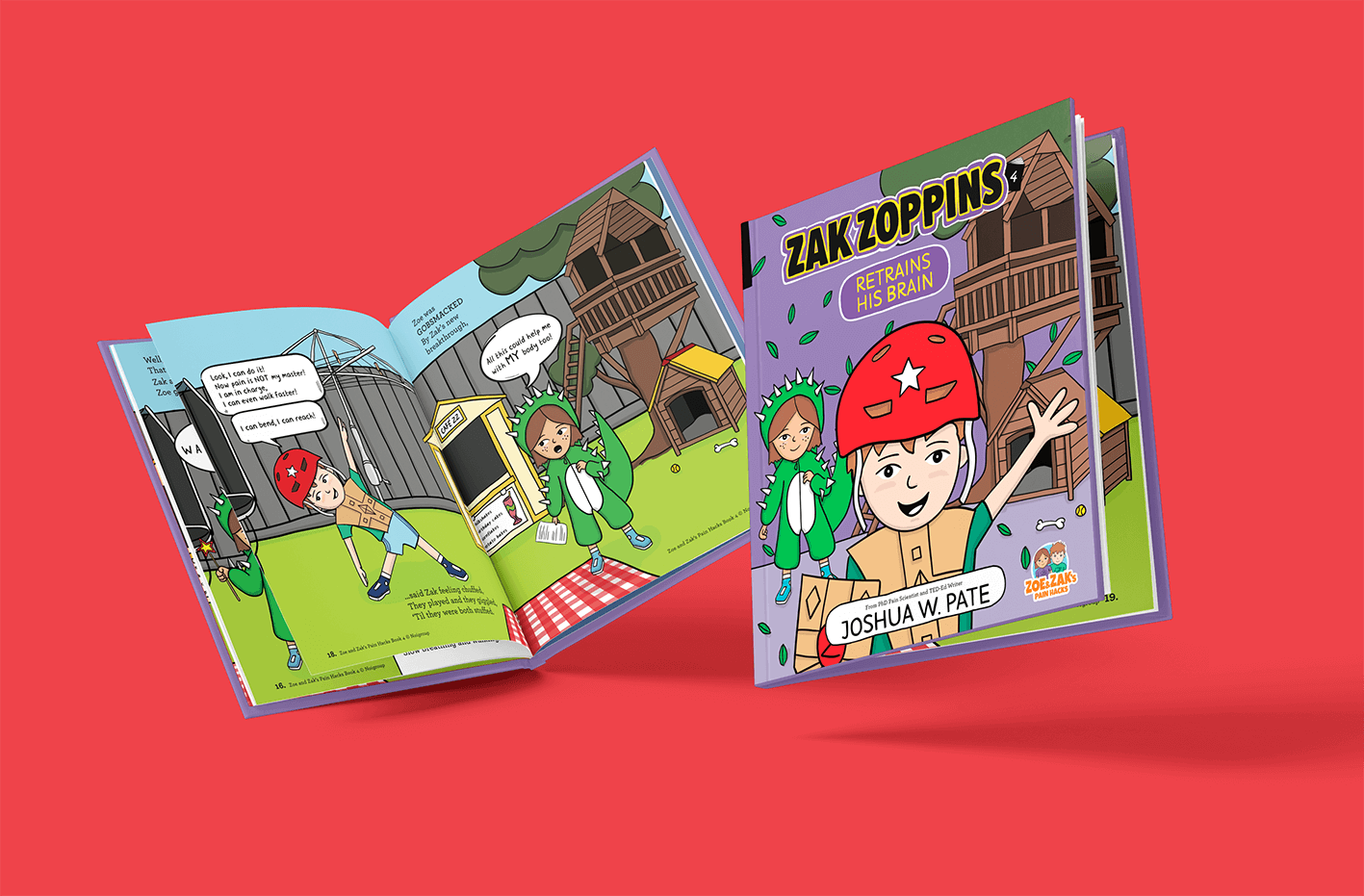
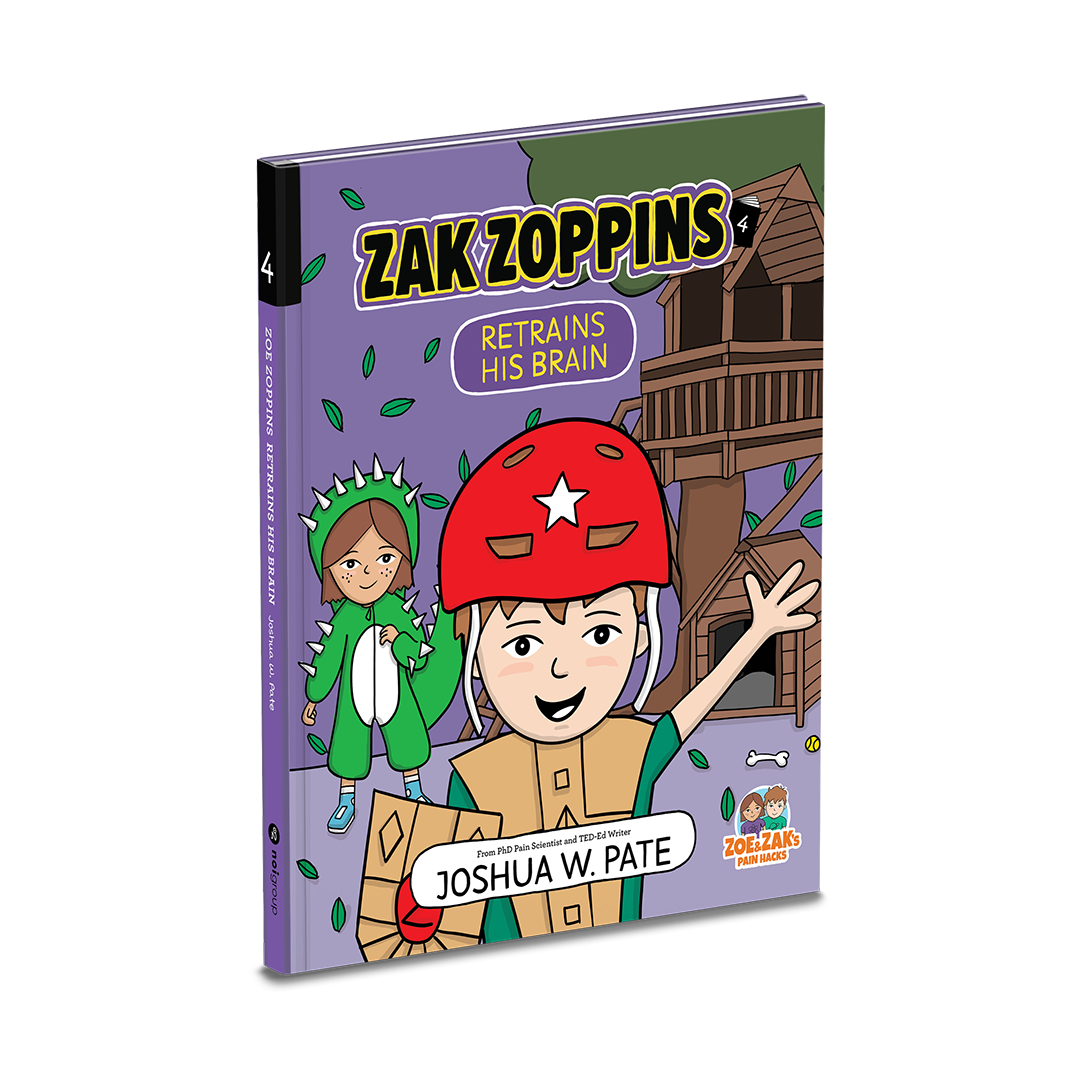
Now that you have read Zak Zoppins Retrains His Brain (book 4) you are ready to take on the next challenge!
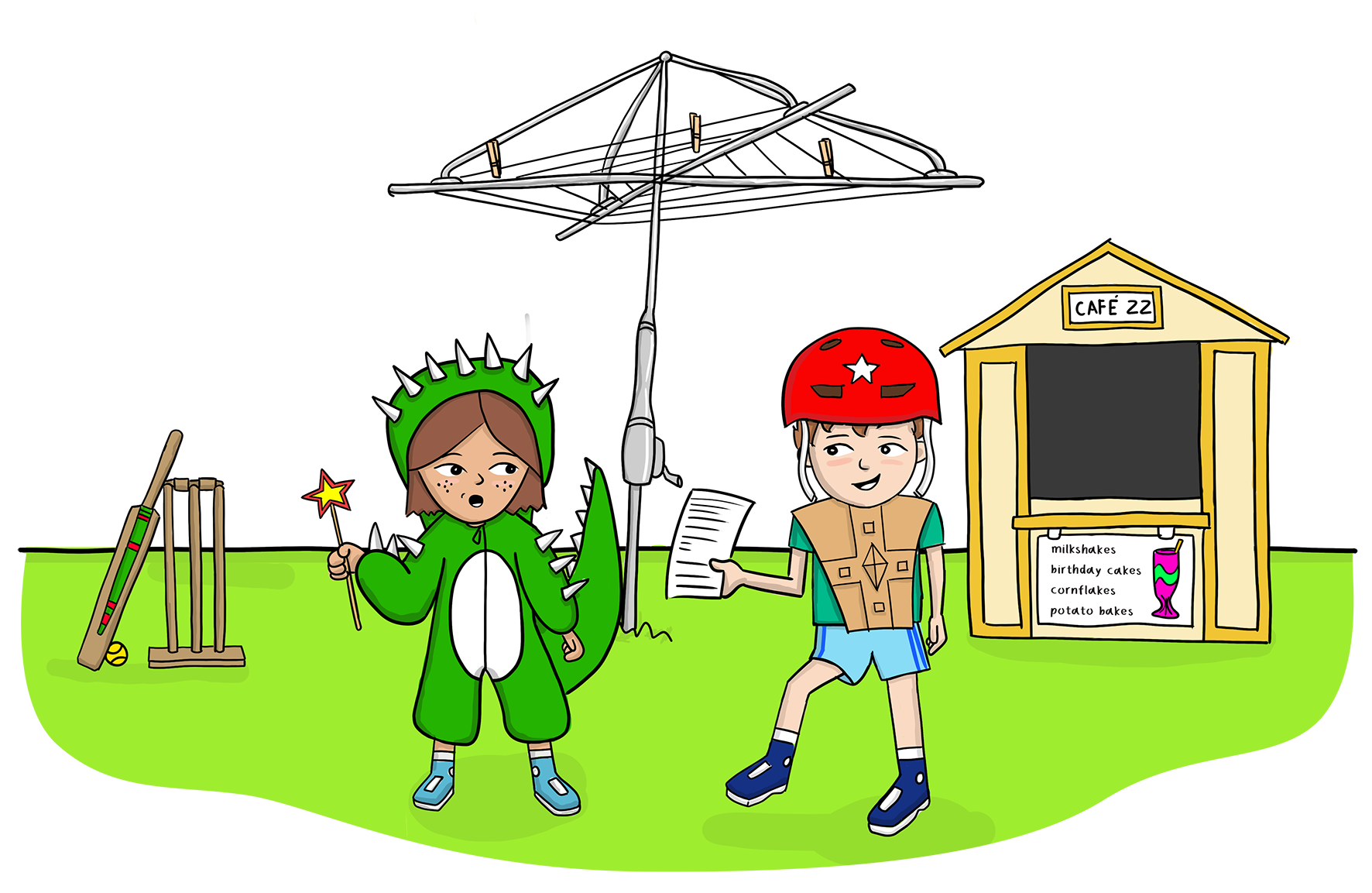
Let's recap the 4th story:
This story focusses on Zak Zoppins. Zoe and Zak are in the backyard together playing all sorts of fun games - dress-ups, cricket, trampolining, art and slides. Zak is sharing his back pain journey and how he has been improving thanks to his 'action-packed action plan'. Zoe decides to make an action plan for her sore tummy.
Get set for some cool activities!
Here are some printable sheets for you to get stuck into...
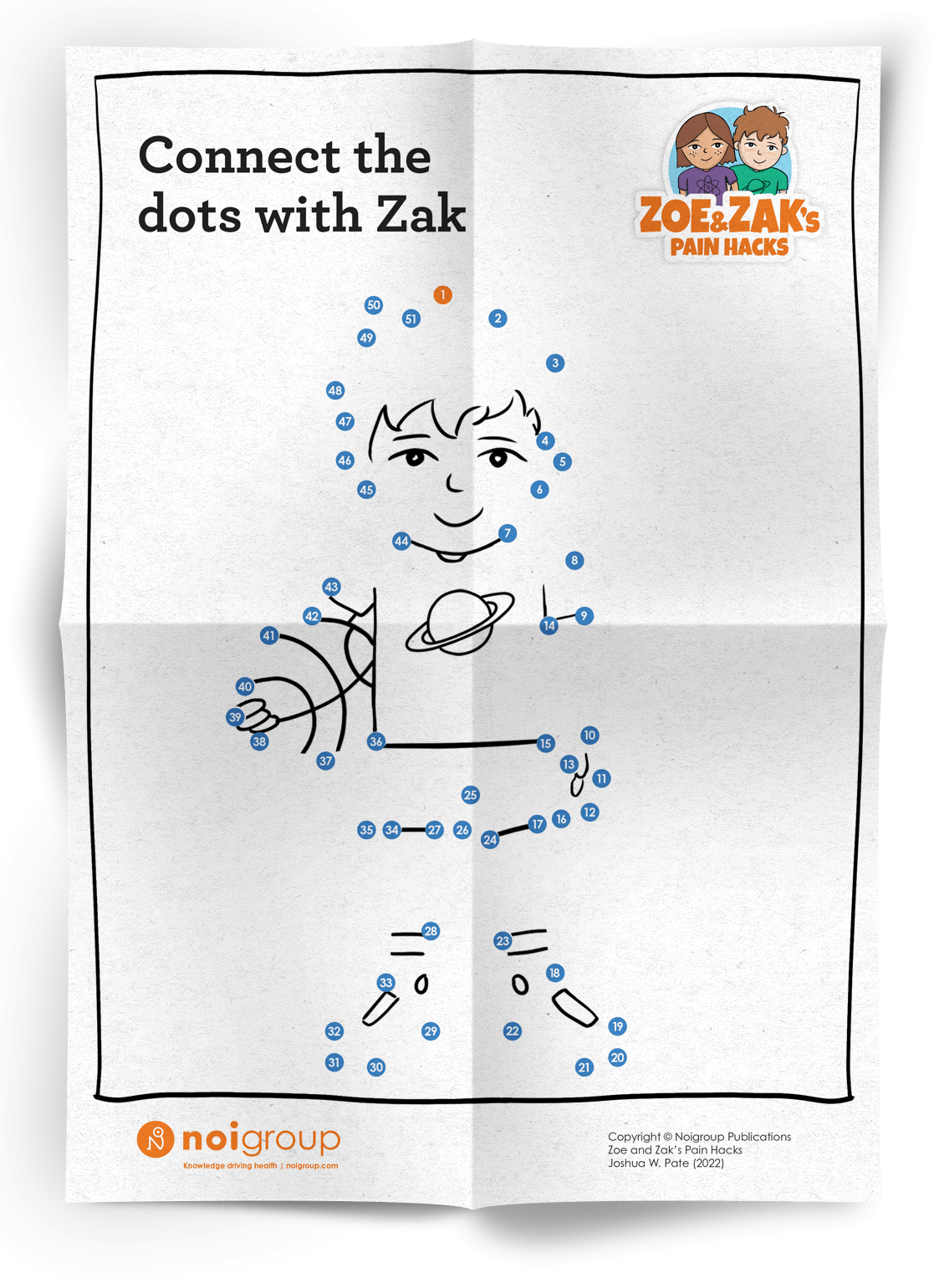
Zak dot-to-dot
Connect the dots in number order to complete this picture of Zak Zoppins
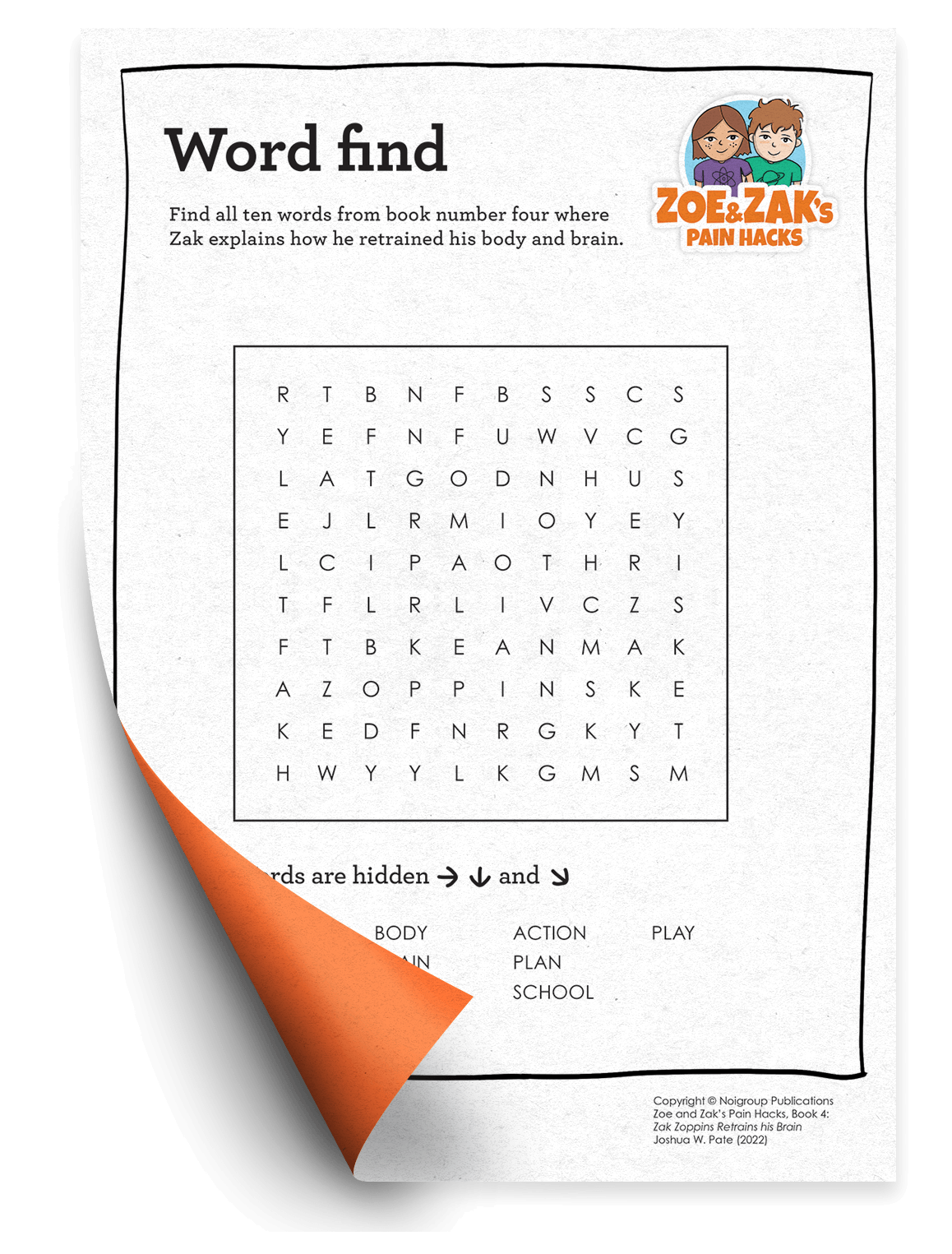
Word find
Find all ten words that describe how Zak retrained his body and brain.
Quiz
This book had five questions at the end, so let’s start with question 6…
6. Did Zak's back pain improve in 1 day?
7. In this book Zoe imagines going on fun adventures with Zak (do you remember the rock climbing image?). What fun adventures would you like to do?
8. Zak's plan helped him to get back to school, and improving his movements (eg. walking, bending, and reaching). Often kids have many goals beyond going back to school. Do you think it would be possible to make a similar plan to Zak, for playing with a friend? Walking your dog? Helping parents with chores/duties at home?
9. Finding out how Zak dealt with pain helped Zoe to grow. What else would YOU like to find out now?
10. Learning requires practice, and retraining brain and body takes practice - MANY repetitions! What other things have you had to practice many times before seeing improvement? Eg.
- Riding a bike
- Playing piano
- Magic tricks
- Swimming
- Reading
- Speaking
- Crawling
- Monkey bars
- Computer games
Our brains and bodies are always changing, and we can make the most of these changes to become the boss! In the next book we’ll learn to make an action plan
Did something here stand out?
Want MORE activities? Select another book...
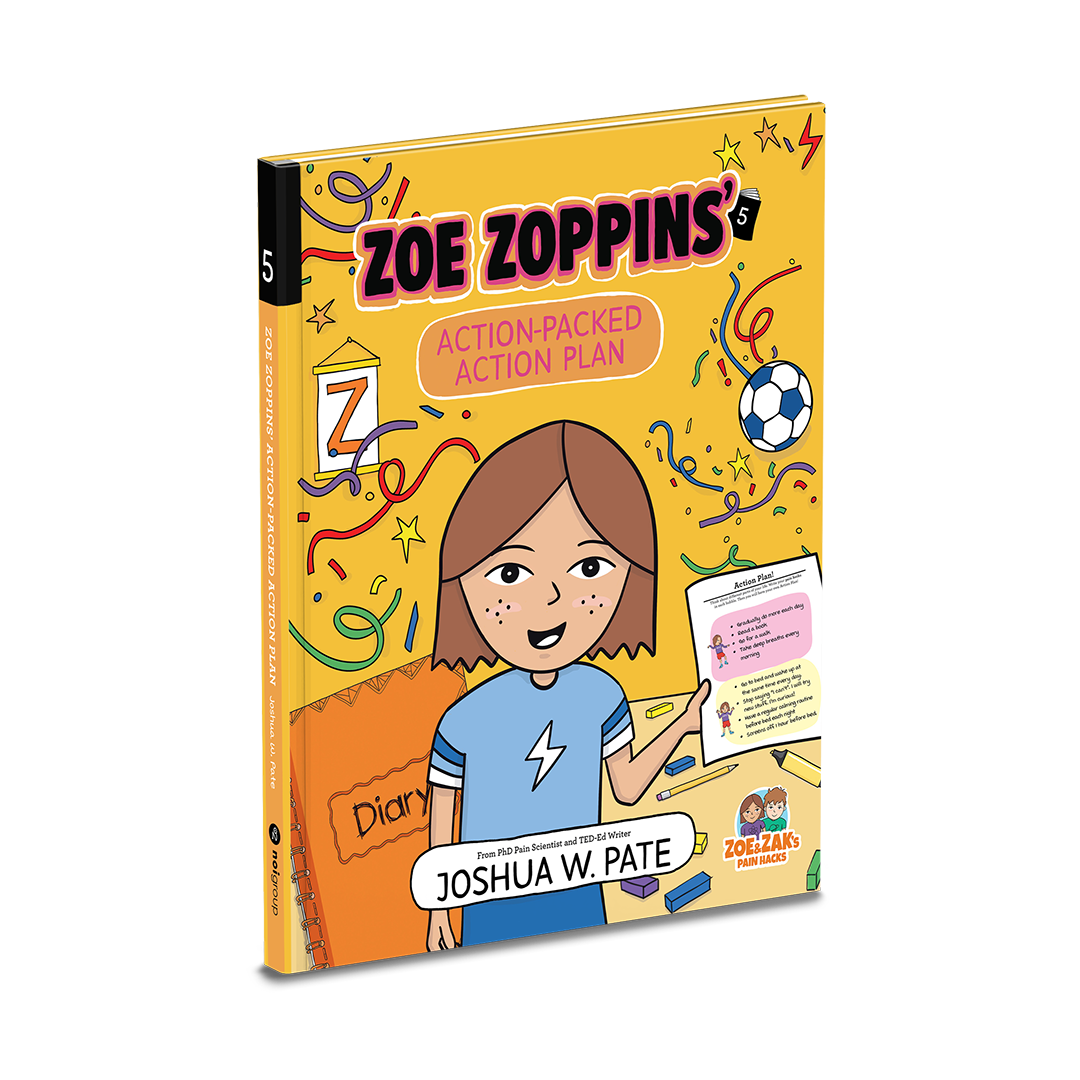
Now that you have read Zoe Zoppins' Action-Packed Action Plan (book 5) you are ready to take on the next challenge!
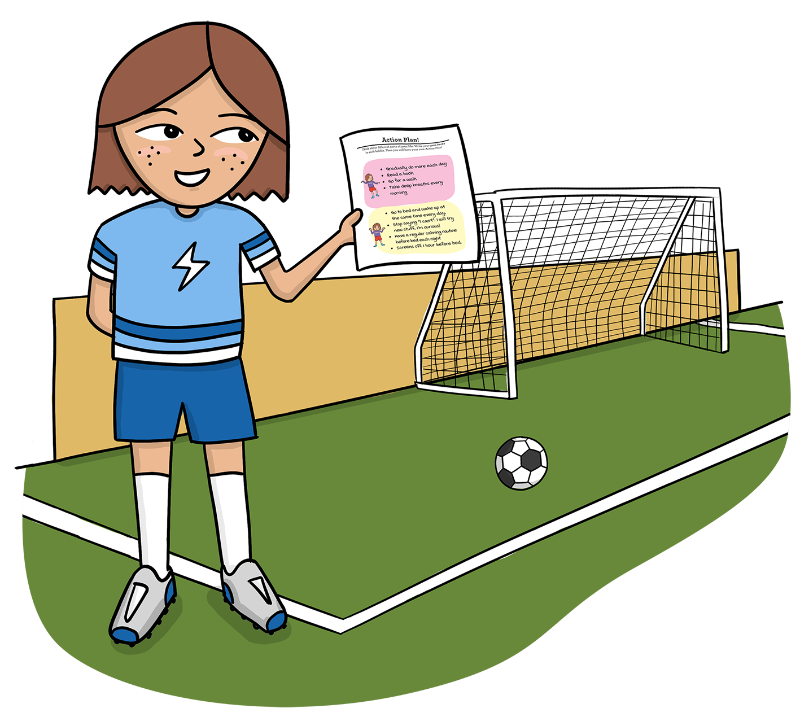
Let's recap the 5th story:
In this book, Zoe shares her diary writing. Her diary is one important part of her action plan that she started seven weeks before. Since doing her action plan, Zoe's understanding of her own pain has improved and she feels like she is the boss again!
Get set for some cool activities!
Here are some printable sheets for you to get stuck into...
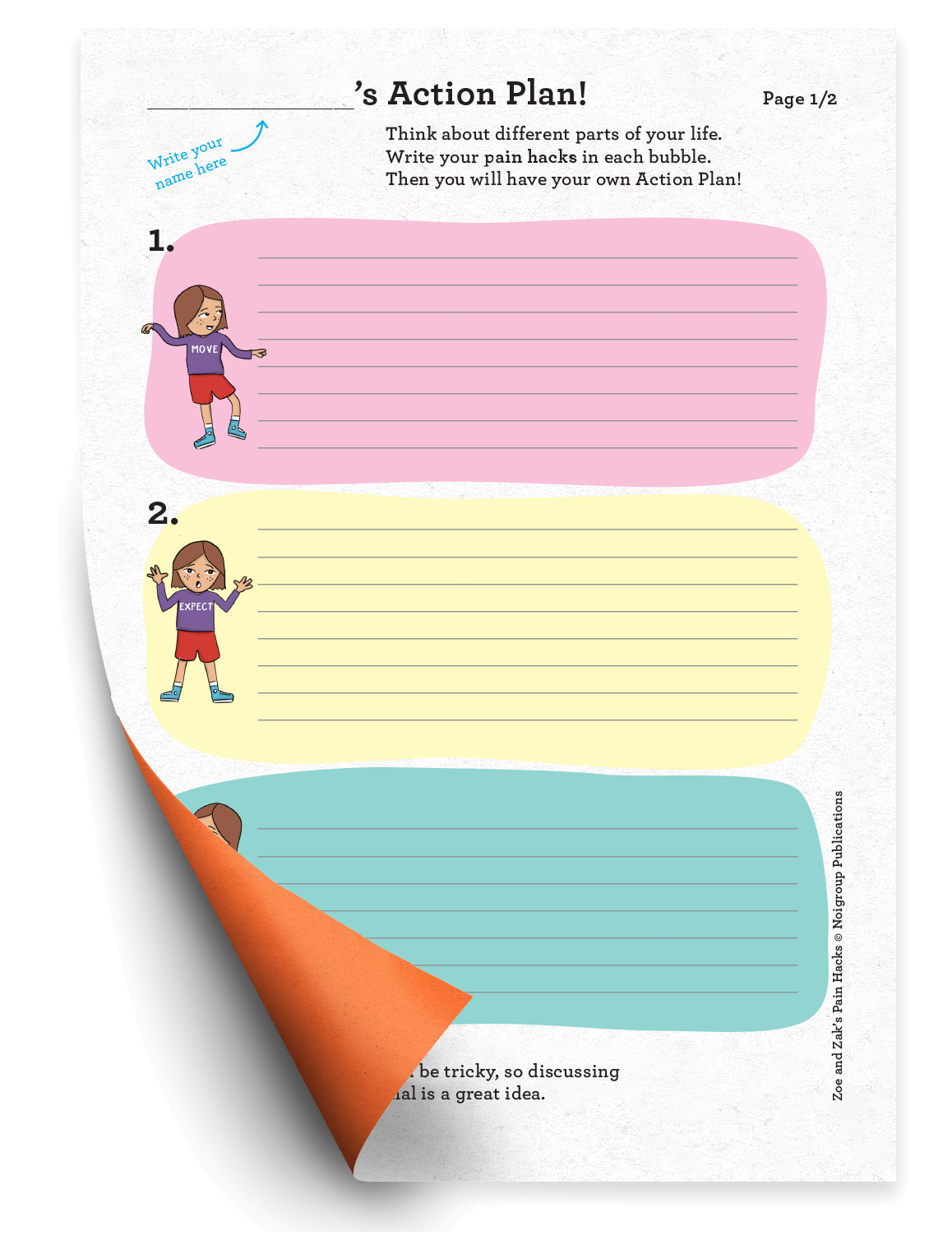
Action Plan
Print out this 2-page Action Plan so that you can make yours action-packed (just like Zoe and Zak!).
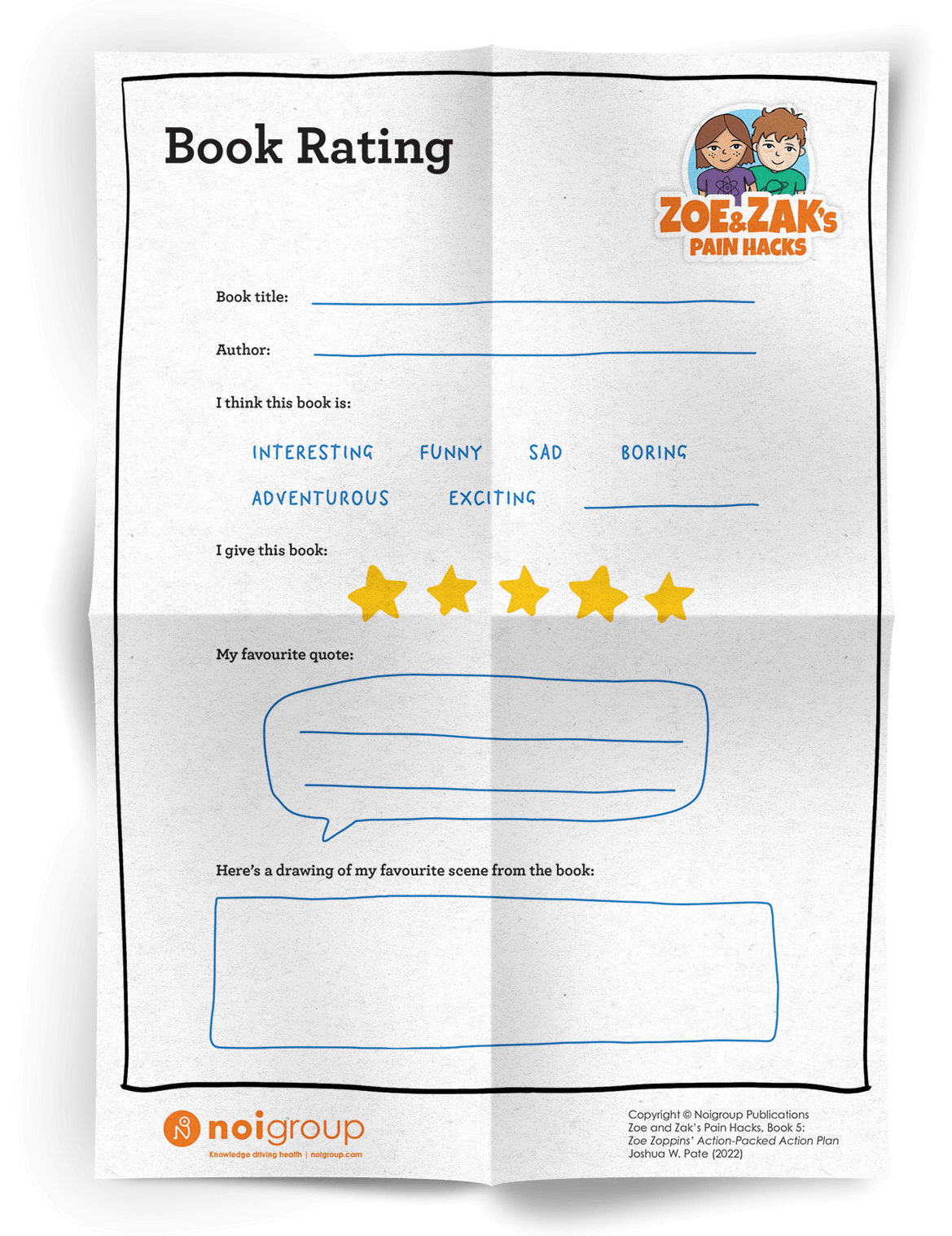
Book review
You will need red and blue pencils, crayons or textas for this one.
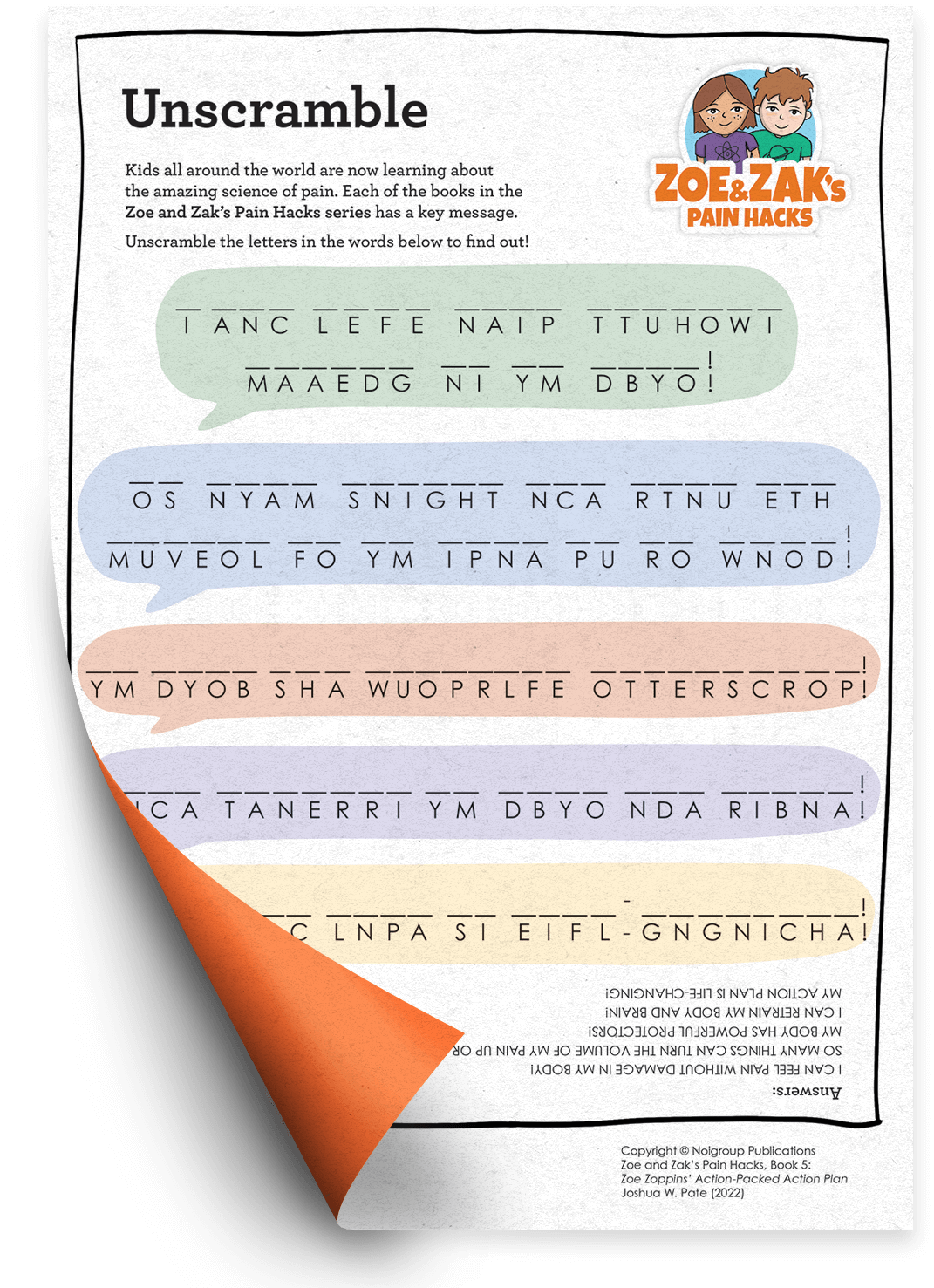
Unscramble
Unscramble the letters word by word to recreate the key message of each book.
Quiz
There were 4 questions at the end of the book, so we will start now with question 5.
5. At the start of this book we found out how many weeks Zoe has been doing her action plan so far. How many is it?
6. Make a list of all the things that Zoe is doing again:
7. Do you think Zoe will keep using her action-packed action plan?
8. We are going to do something we did way back at the start. Go to joshuawpate.com/copi to answer a few questions about your understanding of pain.
Now, have a think about how your answers have changed. What have you learned from this series?
9. Find someone at home and read these dot points together.
- At first, the actions in your plan may not make your pain feel less…But every time you do them it is making you better on the inside!
- After a while you will notice the strategies help your pain / help you cope with the pain better and/or calmer.
- Most often function improves before pain decreases.
- Don't just try your action plan for a couple of weeks. You need to give it a couple of months to ensure you see progress.
- Based on the current science, it is reasonable to expect that (a) pain will go away or (b) it'll be much better, and not bother you as much…
How does all this make you feel?
10. Let's zoom out. What is your worldview? A worldview is the way you see the world. Do you think everything is getting better or worse?
Zoe has decided to be more positive. Reflect now on some of the good things that are happening in the world… It is scientific to think "It's grim, but not all gloom and doom".
11. In Zoe's action plan, she planned to make some signs/posters to remind her of important stuff. Go back through the book, find these phrases, and have a go at making your own signs/posters!
CHALLENGE: Pitch your ideas to Zoe! Send an email finishing one of the following sentences. Zoe (and Josh) would love to hear from you, listening to every single email!
- To make this book series work for younger kids, I think you should…
- To make this book series suitable for teenagers, what you need to do is…
- My idea for book #6 is…
- The main things I learnt from the books are…
Want MORE activities? Select another book...
Online activities for parents, teachers and clinicians!
Select a book:
Don't have the series yet?
Pain is complex and can be difficult to talk about, especially persistent pain – pain that has lasted for longer than expected. The five Zoe and Zak's Pain Hacks books are designed to help children, family, friends, teachers and health professionals all learn about pain and help children thrive!
Parents & Carers
Hi and welcome!
Pain is really complex and it can be difficult to talk about with children. We’ve developed these books to help children learn and talk about pain with their friends, you (as their parents), and even other adults and teachers. Learning about pain can be so great for understanding ourselves, and in turn, this helps us with our wellbeing. Children need to talk about their experiences in order to keep learning as they grow.
As a parent, you may like to have more information. Our team thought that a list of resources (in addition to what’s listed above) could be useful for you if you wanted to learn more for yourself.
With 1 in 5 adults experiencing persisting pain, we want you to be well-equipped! You could check out the following resources:
Clinicians
Hello health professional, we’re glad to have you here! The following resources are specifically for you as a clinician working with children challenged by persistent pain.
First, here is the qualitative research study on which the language in this book was based. This was part of Josh’s PhD.
The story in this book is based on the following anecdote: Fisher JP, Hassan DT, O’Connor N. Minerva. BMJ. 1995;310:70.
Next, here is the Concept of Pain Inventory (COPI) initial validation study. This tool enables (a) targeted pain science education, and (b) the evaluation of the effectiveness of pain science education.
COPI items that may change the most with this book:
- 7. You can feel a lot of pain even when an injury is small.
- 10. The brain can make pain better or worse.
- 14. The brain processes lots of details before you feel pain.
We encourage you to watch this brief video of Josh discussing preventative education with David Butler:
And our final recommendation at this point in the Zoe Zoppins journey is a book for clinicians who want to know a lot more about pain. Go check out Explain Pain Supercharged – the Clincian's Manual (Noigroup Publications, 2017)
Teachers
G’Day teachers! You can play a pivotal role in the future of persistent pain. There are several studies investigating the complexities of how teacher’s think about pain. So far, we know it’s important, and we have some resources to suggest for you.
We encourage you to watch the ‘Mysterious Science of Pain’ video. Perhaps you could watch this as a class, read the first Zoe Zoppins book, and then discuss the questions at the end of the book?
We would love to hear how you find the printable activities. You can contact Josh via the contact page on his website

How to Draw Zoe
You can draw a picture of Zoe. Follow the ten easy steps.
Maze Message
Trace Zoe and Zak's phonecall through the maze collecting the words along the way. Be careful to avoid the nails!
Drawing Pain
Can you draw what pain looks like, or feels like?
Book reflection
You can draw a picture of Zoe. Follow the ten easy steps.
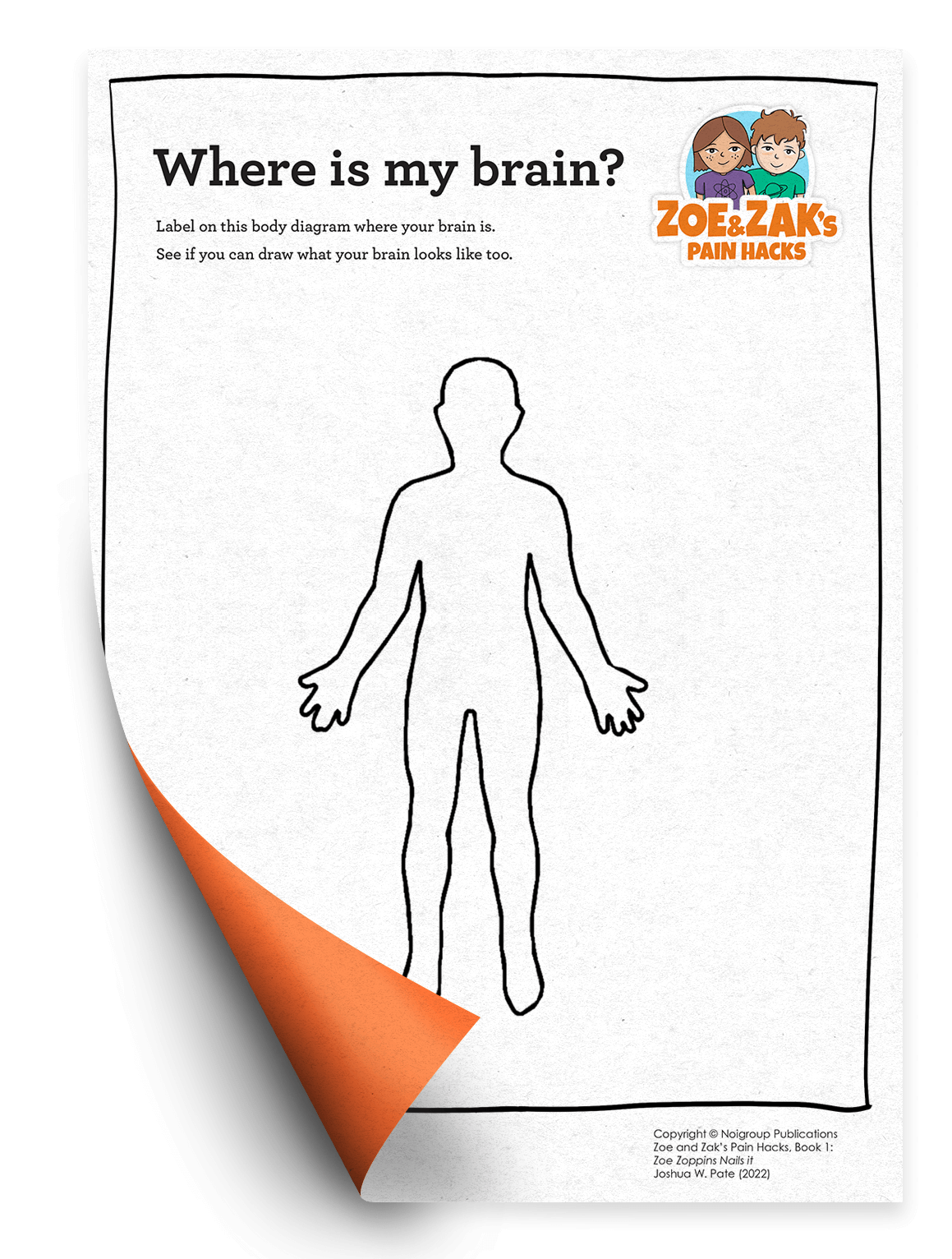
Where is your brain?
What does it look like? What about your spinal cord and nerves - do you know where they are?
Do you want to see the online activities (parents, clinicians, & teachers) for the other books in the series?
Also, here are the links to the Kid's pages for each book:
Parents & Carers
Hello parents, we hope this book has been an exciting read for you too!
For many adults, re-conceptualising pain as a changeable experience is quite confronting, so there are some great resources available to head down that path if you are interested.
After you chat through the discussion questions and bonus questions with your child, you might want to have a look at this TED-Ed video on phantom limb pain that Josh wrote - https://www.youtube.com/watch?v=KdihphPp1Q0 – it explains the idea of a map in your brain and goes a bit deeper than the 2nd Zoe Zoppins book.
As always, we’d love to hear how you are trekking along this journey to learn about the science of pain!
Clinicians
Hi clinicians! The experiment in this book is based on this study by Lorimer Moseley and Arnoud Arntz - https://doi.org/10.1016/j.pain.2007.03.002
Many clinicians find this study to be a useful starting point for pain science education, because it is so surprising. Children under the age of 12 haven’t typically developed the ability to think abstractly, so the questions in the book around “what else could this apply to?” may be very challenging. Therefore, we encourage you to have some concrete examples ready to go.
Have you seen the ‘thermodol’ paper too? https://www.nature.com/articles/s41562-019-0749-5
And, smell affects nociceptive withdrawal! Bartolo et al., 2013 PAIN article https://pubmed.ncbi.nlm.nih.gov/24040974/
COPI items that may change the most with this book:
- 1. Feeling stressed can make you feel more pain.
- 2. Feeling sad can make you feel more pain.
- 3. Being distracted can make you feel less pain.
- 4. Doing something you enjoy can make you feel less pain.
- 14. The brain processes lots of details before you feel pain.
Try working through pages 20-21 with a child and identify which activities are most relevant for their situation.
Teachers
Teachers, we think that the suggestions on pages 20-21 would be a fun topic of conversation in a classroom discussion. What do you think?
The bonus questions may help to guide the conversation.
We would love to get your feedback on how you have implemented this content in your class, so please reach out. Collaborations between the health and education sectors are so important!
Hot and cold
You will need red and blue pencils, crayons or textas for this one.
Pain volume 1.
Think about things in your life that may make your feeling of pain go up or down. We have given you some ideas.
Pain volume 2.
Write down things in your life that may make your feeling of pain go up or down.
Do you want to see the online activities (parents, clinicians, & teachers) for the other books in the series?
Also, here are the links to the Kid's pages for each book:
Parents & Carers
Hi caregivers, well done on journeying with your child through the first 3 books.
Our nervous systems are incredible, and so you are setting a brilliant example to your child by joining them in all this learning.
After you have worked through the discussion questions and bonus online content, perhaps you could print off a worksheet above and take it to your child’s next medical appointment?
People all around the world can use these books as a platform to speak the same language as your health professional, and improve the tricky decision-making processes that come with the challenge of persisting pain.
Clinicians
Welcome back healthcare professionals! Unpacking the complexity of the brain can be quite daunting when providing care to a child challenged by pain, but our hope is that this book will be a conversation-starting point.
Recent research on predictive processing has provided an alternative method of understanding different ‘levels’ of the nervous system, and how it adapts and acts upon identified threats.
COPI items that may change the most with this book:
- 5. Pain is a warning that the body needs to be protected.
- 6. Feeling pain for a long time can make the brain more sensitive to warning messages.
- 14. The brain processes lots of details before you feel pain.
For extended reading, we encourage you to dig into Louie Gifford’s mature organism model.
Page 13 of this third book is a helpful starting point to work through and apply – so we made a worksheet (see q6 on the Kids page) for you to print off and share with children. The goals here are a sense of awe and increased interest, to stimulate longer term changes and a strong commitment to treatment strategies.
Teachers
G’Day teachers, grab the worksheets and run with them however you would like to.
Again, if you have feedback, ideas, stories, or suggestions, please contact us.
Our goal is to continue to improve the resources available.
As access to VR technology improves, books like this one will become more commonplace, so it’s great that you are leading the way!
Puppet show
Colour in and cut out the characters, then tape onto your fingers to re-enact the Brainy Adventure story!
Brain messages
Think about things in your life that may make your feeling of pain go up or down.
Do you want to see the online activities (parents, clinicians, & teachers) for the other books in the series?
Also, here are the links to the Kid's pages for each book:
Parents & Carers
And hello again caregivers!
Once you have read the 4th book and tried out the worksheets above, you may have questions. We’d encourage you to write these down and seek out a health professional trained specifically in paediatric pain rehabilitation. They can use what you have been learning as a foundation for a plan that navigates the ups and downs of pacing or graded exposure.
Remember, the principles in these books aren’t only for tummy pain or back pain, they apply to all pain locations.
If you have any feedback to the team developing these online resources, please let us know! We carefully consider these emails and value your input enormously.
Clinicians
Hello again healthcare professionals! This book is an introduction to graded exposure and pacing. Zoe’s cousin Zak has successfully improved his function in this book, and in the next book we’ll see that Zoe does too!
Before diving straight into treatment, a paediatric-specific assessment is essential. Here is a paper focussed on low back pain in children, but the principles are the same for other musculoskeletal conditions:
- Pate JW, Joslin R, Hurtubise K, Anderson DB. Assessing a child or adolescent with low back pain is different to assessing an adult with low back pain. Journal of Paediatrics and Child Health. https://doi.org/10.1111/jpc.15933
The scientific evidence supports exercise as part of multidisciplinary rehabilitation for persistent pain. Movement is not only safe but one big key to improving:
- Harrison LE, Pate JW, Richardson PA, Ickmans K, Wicksell RK, Simons LE. Best-Evidence for the Rehabilitation of Chronic Pain Part 1: Pediatric Pain. Journal of Clinical Medicine. 2019; 8(9):1267. https://doi.org/10.3390/jcm8091267
COPI items that may change the most with this book:
- 10. The brain can make pain better or worse.
- 13. Pain usually feels better if you move your body a little bit more each day.
Zak’s plan on page 19 is a wonderful starting point for a child to start seeing a glimpse of a ‘success story’. The worksheet above on this page can then be printed off and completed with patients. We would love to hear how you find these papers and activities as we want to iteratively improve the content on these pages, so please let us know what you think!
Teachers
Hi teachers, you may have seen the worksheets already - we think that by now you know that you have full license to take them and use them how you please in a classroom setting.
As always, please contact us if you have feedback, ideas, stories, or suggestions.
The dream of preventative pain science education (‘mass conceptual change’, just like the Slip Slop Slap campaign of the 1980’s in Australia) is just beginning!
Zak dot-to-dot
Connect the dots in number order to complete this picture of Zak Zoppins
Word find
Find all ten words that describe how Zak retrained his body and brain.
Do you want to see the online activities (parents, clinicians, & teachers) for the other books in the series?
Also, here are the links to the Kid's pages for each book:
Parents & Carers
Hi parents! Congratulations on reaching the final instalment of this online platform.
Creating an action plan is hard work. We hope that the templates below, when used in conjunction with this 5th book, will set the scene.
Once you and your child have started brainstorming your plan – take it to a health professional and ask for advice about it.
Clinicians
Hi health professional! Well, here we are at the end of the final book in the series. Here are some more resources specifically for you as you work alongside children challenged with persistent pain.
First, here is a paper about different sticking points that children (and their parents) have when arriving at a clinic.
Second, a fascinating paper from Maria Pavlova for you about parent-child reminiscing about past pain experiences: What you say, and how you remember, matters! https://doi.org/10.1016/j.jpain.2021.08.002
Third, complete the COPI again – have any scores changed?
COPI items that may change the most with this book:
- 8. Learning about pain can help you to feel less pain.
- 9. You can have an injury and feel no pain.
- 10. The brain can make pain better or worse.
Teachers
Hi teachers, we hope this final book has been useful for you in your teaching. We have received positive feedback about how these books fit within recent wellbeing frameworks throughout the world, and so if you have any input about how these resources can embedded in your learning systems, please let us know! The future of pain science education in schools is bright!
Taking your class through the book review activity above would be a wonderful way to wrap up the journey that you have taken them on. After the class completes their reviews, we'd love to hear some of the quotes – you can email us with scanned copies of these documents or set up a brief meeting to discuss further. Our hunch is that this online platform can continually grow and improve, and teachers are absolutely essential for that to occur.
The other opportunity we see you now have is an advocacy role. Are there other teachers in your network that may benefit from this series of resources? Would a professional development event be useful? Our hope in raising these questions is to broaden the reach of these important pain science messages.
So, enjoy the free worksheets and do feel welcome to contact us.
Action Plan
Print out this 2-page Action Plan so that you can make yours action-packed (just like Zoe and Zak!).
Book review
You will need red and blue pencils, crayons or textas for this one.
Unscramble
Unscramble the letters word by word to recreate the key message of each book.
Do you want to see the online activities (parents, clinicians, & teachers) for the other books in the series?
Also, here are the links to the Kid's pages for each book:
What is chronic pain?
Chronic pain is defined as pain that has persisting longer than expected (longer than tissue healing time), typically around 3 to 6 months. Chronic pain and stress are experienced by approximately 20% of the global population. The cost is huge and dollar/pound/euro figures do not cover the impact on families and loss of creativity and productivity and its social impact. As many as one in four children experience chronic pain. About 5% of children have moderate to severe pain. The ultimate goal of this new book resource is to reduce the overall burden of chronic pain.

About the authorDr Joshua W. Pate, PhD MRes MPhysio
Josh is a pain scientist, children’s book author, clinician and educator from Sydney, Australia. His PhD drove him deep into the world of investigating what people, particularly children, think about pain. Working with a team of leading pain researchers, the Concept of Pain Inventory (COPI) was developed and published in 2020. Since then, Josh has worked as a university lecturer, and the COPI tool has begun being adapted for different age groups and languages.
Josh has also written for TED-Ed animations about pain, and is a co-founder of the One Thing platform (onething.painsci.org). By building learning resources like this Zoe and Zak Pain Hacks series, Josh dreams that the next generation can (and will!) benefit from learning about the complexity of the science of pain.
But first and foremost, Josh is husband to Anna and a dad who LOVES reading to their three kids.
About the book series
Clinicians, educational experts, and researchers from around the world have reviewed and endorsed these books as helping educators to work effectively with children challenged by persistent pain. This book series can help:
Children living with chronic pain
• to learn about their body’s incredible protective system
• to feel acknowledged and validated in their experiences
• to actively engage with school, sports, family and friends
Parents and caregivers
• to develop an understanding of the complexity of pain
• to encourage evidence-based discussions with children
• to help children thrive
Clinicians working with paediatric chronic pain
• to have up-to-date and targeted resources that will form the foundation for pain education
• to easily integrate the latest neuroscience into pain treatment programs
School teachers
• to guide children experiencing pain through strategies to maximise class participation
• to promote wellbeing and resilience for all children through the lens of pain
About the publisher
Neuro Orthopaedic Institute Australasia (Noigroup) is a privately owned education provider and publishing house working predominantly from an office in Adelaide, Australia, and more recently – New York, US. The company prides itself in its reinvestment in education and clinically based research and Noigroup Publications has grown from the demand for resources to support this emerging research. Now entering its fourth decade, Noigroup manages highly qualified instructors, on all continents, presenting the latest in pain science to multidisciplinary audiences. Noigroup’s faculty members are active in many conferences, university programmes and other postgraduate education sessions.

More resources
Painaustralia is Australia’s leading pain advocacy body working to improve the quality of life of people living with pain, their families and carers, and to minimise the social and economic burden of pain on individuals and the community.
Welcome to the Zoe and Zak's Pain Hacks book series!
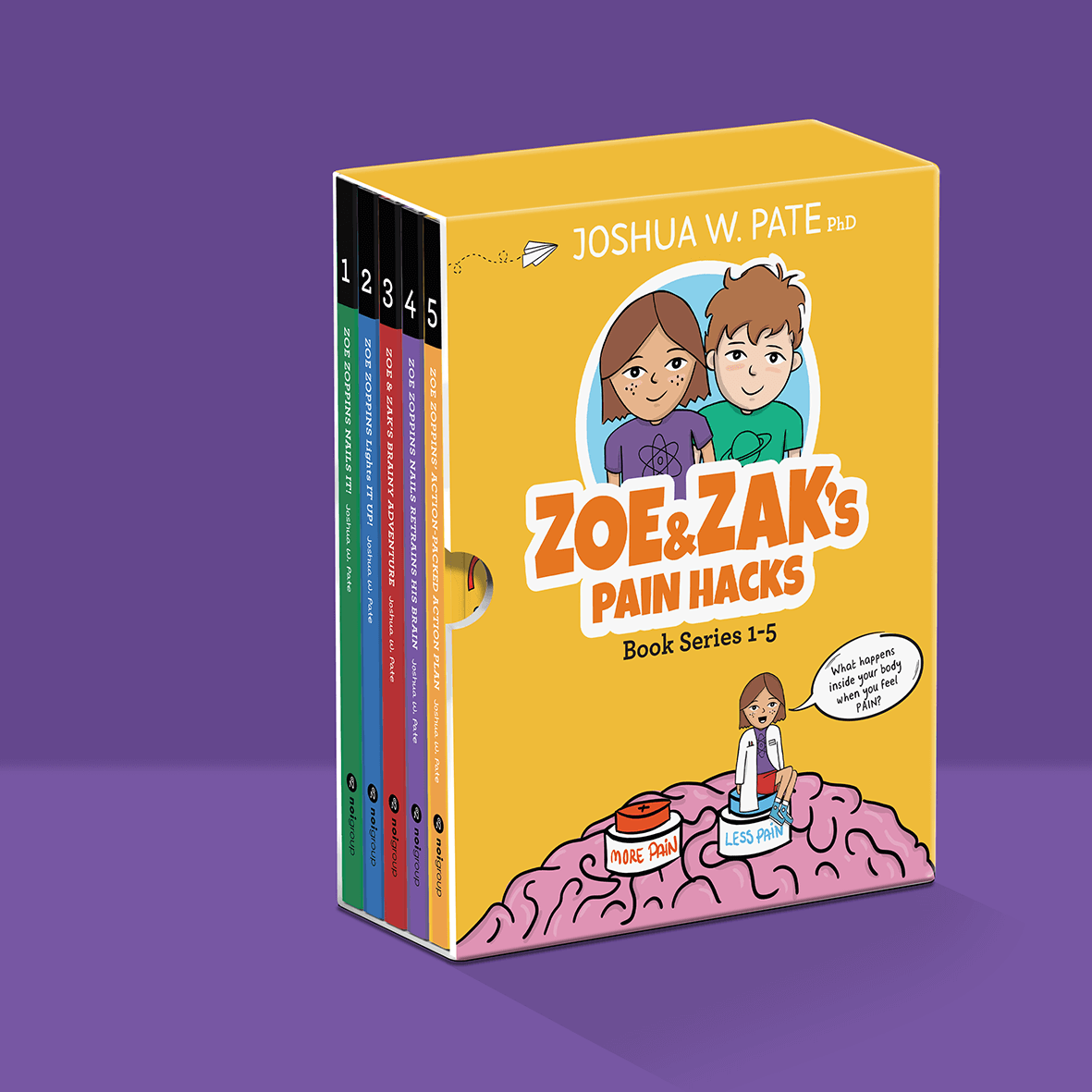
Join Zoe and Zak Zoppins to learn how pain science can be AMAZING!
Pain is complex and can be difficult to talk about, especially persistent pain – pain that has persisted for longer than expected. Zoe and Zak’s Pain Hacks is a series of five books designed to help children learn and talk about pain with their family, friends, teachers and health professionals. The first four books each address one key target concept, the fifth book brings these learning outcomes together with an empowering action plan. Used together, these books are targeted pain science education at its best.
Clinicians, educational experts, and researchers from around the world have reviewed and endorsed these books as helping educators to work effectively with children challenged by persistent pain. This book series can help:
Children living with chronic pain
• to learn about their body’s incredible protective system
• to feel acknowledged and validated in their experiences
• to actively engage with school, sports, family and friends
Parents and caregivers
• to develop an understanding of the complexity of pain
• to encourage evidence-based discussions with children
• to help children thrive
Clinicians working with paediatric chronic pain
• to have up-to-date and targeted resources that will form the foundation for pain education
• to easily integrate the latest neuroscience into pain treatment programs
School teachers
• to guide children experiencing pain through strategies to maximise class participation
• to promote wellbeing and resilience for all children through the lens of pain.
Storylines
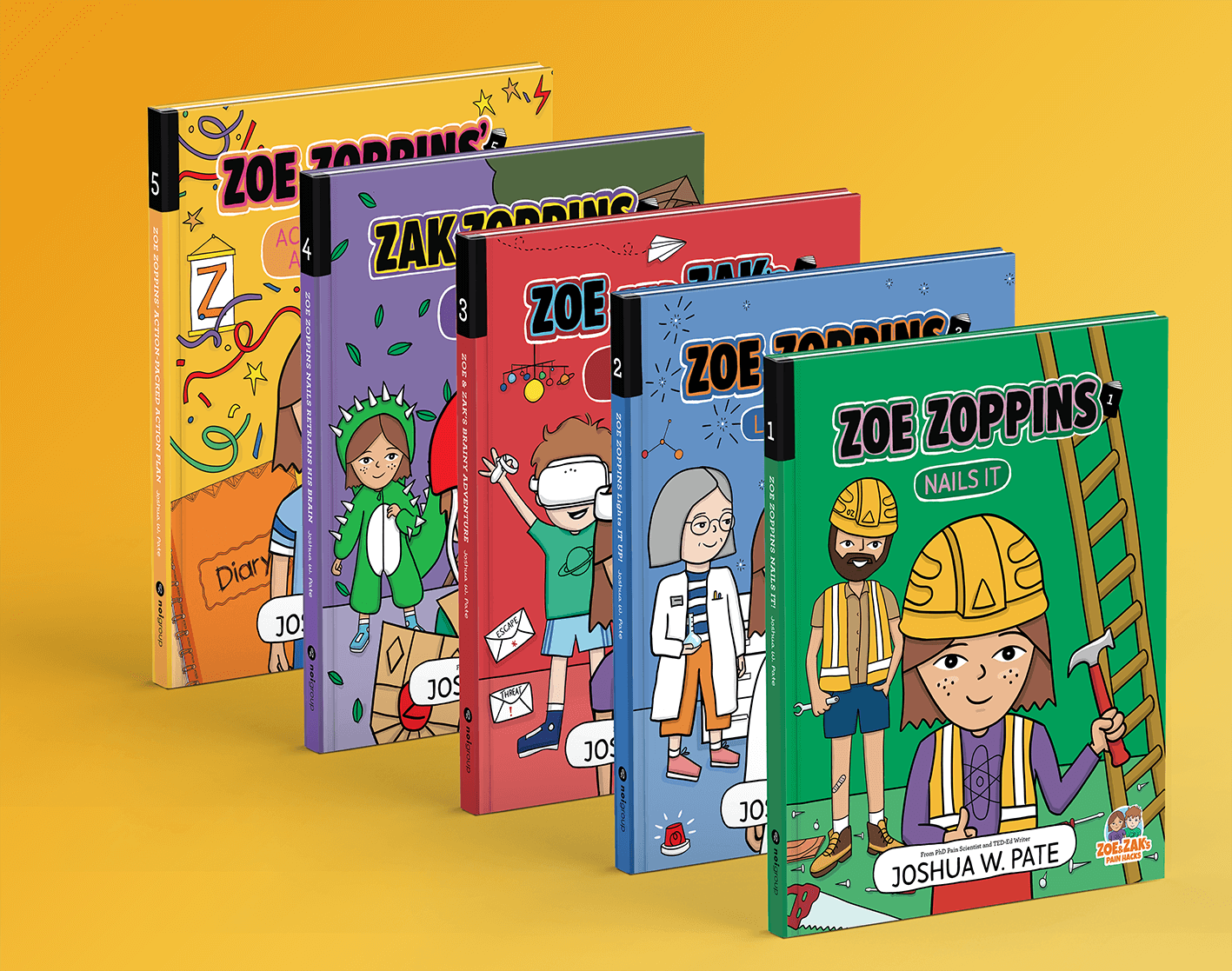
Book 1 Zoe Zoppins Nails it: Zoe is with her Uncle Ozzie who has an alarming accident, with a surprising outcome! They all learn that feeling pain does not necessarily mean your body is damaged.
Book 2 Zoe Zoppins Lights it up: Zoe visits her Grandma Lizzie’s science lab where a colourful experiment reveals something amazing about pain and the brain. Zoe learns anything and everything can change her pain!
Book 3 Zoe and Zak’s Brainy Adventure: Zoe, Zak, and their classmates explore the brain through a mind-blowing virtual reality experience. The students learn that pain is one of their body’s powerful protectors!
Book 4 Zak Zoppins Trains his Brain: Zak explains to Zoe how he is retraining his body and his brain with his action-packed action plan – he is getting back to school! Zoe wonders whether she could use a similar plan for her tummy pain?
Book 5 Zoe Zoppin’s Action-packed Action Plan: Zoe is seven weeks into her own action plan. Through her diary entries on a typical day, we see all she has learned so far. Having an action-packed-action plan can be life-changing!
The Zoe Zoppins books are a set, carefully produced as a complete learning journey, and are not available separately.
Noigroup Publications
Joshua W. Pate
ISBN 978-0-9873426-2-1
Slipcase containing 5 hardcover books, 28-40pp.

Congratulations!
Very few champions find this hidden page when reading Zoe and Zak's Pain Hacks books. You are one of them!
Why not explore more activities about the first book in the series?